

There are projects that introduce an artist to the world, and there are projects that confirm what the world has already begun to understand.
“XX” belongs entirely to the second category.
Fally Ipupa does not reposition himself here. He refines a position already earned across two decades of movement between Kinshasa, Paris, global stages, and digital circulation. The album is not an entry point. It is a statement of control — over sound, identity, and cultural direction.
The Visual Language of Control
Fally Ipupa has always understood that image is not decoration — it is infrastructure.
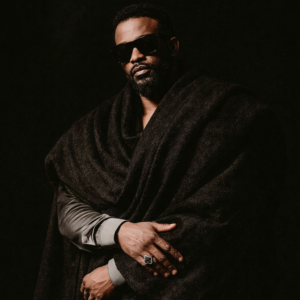
On camera and on stage, his presence operates with a specific kind of restraint: sharply tailored silhouettes, still posture before movement begins, gestures reduced to what is necessary. It is fashion language translated into performance grammar — not performative, but deliberate.
Even in rehearsal spaces, there is rarely excess motion. A hand adjusts a cuff. A glance resets a room.
That same discipline runs through “XX”. Nothing feels overstated. Nothing is left unresolved. Even when the music expands, it does so with structure rather than chaos.
This is not the aesthetic of arrival. It is the aesthetic of permanence.
Two Sonic Worlds, One Creative Authority
“XX” is constructed across two distinct sonic environments, but both are governed by a single centre of gravity.
One world is outward-facing — Afropop, R&B architecture, and modern global production designed for cross-border circulation. It is fluid, engineered for scale, and built to move through contemporary digital ecosystems without friction.
The second world withdraws into Congolese rumba — not as reference, but as foundation. Here, time is allowed to stretch. Guitar lines linger slightly longer than expected. Percussion speaks in conversation rather than impact. Vocals sit just behind the beat, as if refusing urgency on principle.
Together, these two environments do not compete. They complete each other.
Features as Orbit, Not Foundation

The collaborators on “XX” do not define the structure of the album. They orbit it.
Wizkid enters as a parallel global voice — an artist operating within the same continental expansion of sound, where melody and restraint replace excess and noise. The exchange feels effortless, like two systems already calibrated to the same frequency.
Angélique Kidjo brings generational authority, a presence that carries decades of African cultural projection into global recognition. Her voice lands with the weight of history, but never interrupts the present.
DJ Maphorisa introduces South African production intelligence — layered, rhythmic, and deeply engineered for movement. The textures feel built for both club systems and headphone precision.
Lokua Kanza anchors the emotional and cultural core, reconnecting the album directly to Congolese musical lineage and interpretive depth. His presence feels less like collaboration and more like continuity.
Across additional voices from the Francophone and diaspora urban landscape, the album extends its reach without losing centre.
But nothing shifts its direction.
Fally Ipupa remains the axis.
The Discipline of Not Overreaching
In contemporary music culture, expansion is often mistaken for multiplication — more features, more genres, more volume, more noise.
“XX” resists that logic.
Instead, it operates through filtration. Every sonic decision feels selected rather than accumulated. Every feature is placed within structure, not above it. Every transition feels intentional, even in its quietest moments.
This is what separates output from authorship.
Fally Ipupa is not demonstrating versatility here. He is demonstrating control.
Global Positioning Without Performance
The most striking quality of “XX” is what it does not attempt to do.
It does not perform global relevance. It operates within it.
Fally Ipupa is already embedded in a transcontinental music system where African pop is no longer peripheral, but central. The album reflects that reality without needing to declare it.
Its confidence is structural, not rhetorical — the kind that does not raise its voice because it does not need to.
Longevity as Design
Few artists maintain coherence across decades of shifting African and global music economies. Fewer still do so without losing identity to reinvention cycles.
“XX” is built on continuity — not repetition, but evolution with discipline. It reflects an artist who understands that longevity is not sustained through constant transformation, but through controlled expansion.
What remains consistent is identity. What evolves is expression.
Closing Frame
When the lights rise again, nothing in the room has changed — except perception.
A chair is pushed slightly back from where it was. A playback track has ended mid-air. Someone quietly closes a case that was never fully opened.
“XX” does not ask to be introduced. It behaves like something already established: structured, confident, and fully authored.
Wizkid, Angélique Kidjo, DJ Maphorisa, Lokua Kanza, and others appear not as anchors of attention, but as confirmations of reach — signals of an ecosystem already surrounding the artist rather than forming around him.
In a global music landscape driven by speed, “XX” chooses control.
In a culture driven by visibility, it chooses structure.
And in doing so, it does not announce Fally Ipupa’s position.
It simply shows it — already in place, already defined, already undeniable.