
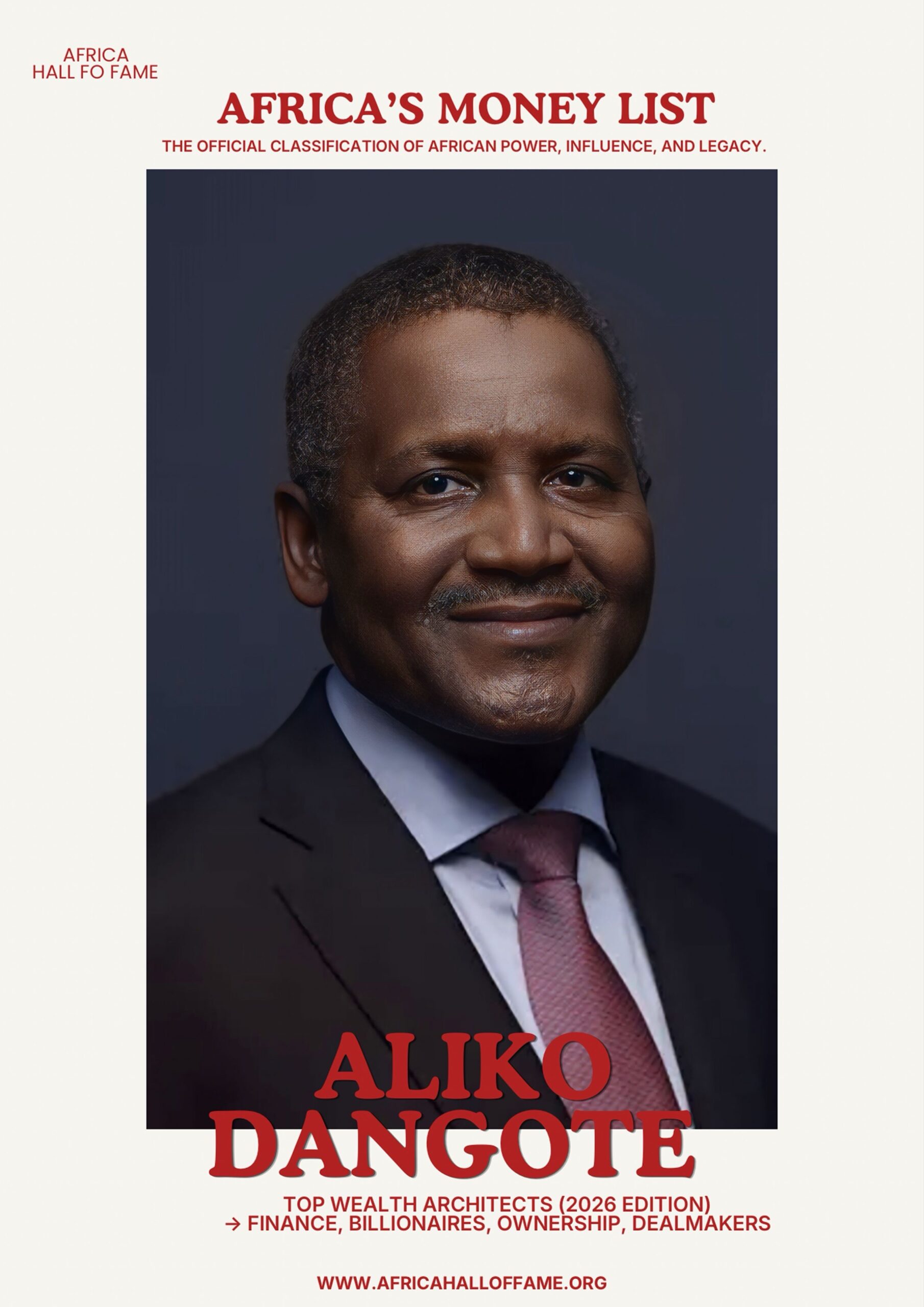
Africa’s Money List — The Top Wealth Architects Shaping the Continent’s Economic Power
Aliko Dangote: The Quiet Architecture of Industrial Power
In global capitalism, the most consequential figures are not always the most visible. Some sit in plain sight, their influence embedded so deeply into supply chains and pricing systems that their absence would register before their presence is even acknowledged.
Aliko Dangote belongs to that category.
Across Africa’s industrial landscape, his name is less a brand than a structural constant—an operating layer within the continent’s economic machinery. Cement plants, sugar refineries, salt production lines, fertiliser distribution networks: sectors that rarely attract public imagination but determine the physical possibility of modern life.
What distinguishes Dangote is not simply scale. It is density of integration. His businesses do not sit beside African economies—they sit inside them.
The Economy Beneath the Economy
Africa’s post-liberalisation growth story has often been told through consumption, technology adoption, and services expansion. Dangote’s trajectory runs in the opposite direction: production first, visibility later.
Where many conglomerates expanded outward into diversified portfolios, his model moved inward—toward essentials. Cement became the foundation not because it was aspirational, but because it was unavoidable. Roads, housing, and infrastructure all converge on it. Control the material of construction, and you indirectly influence the pace of national development.
From there, the logic compounds. Sugar is not retail; it is food system infrastructure. Fertiliser is not commerce; it is agricultural yield itself. Salt is not branding; it is mass consumption dependency.
This is not portfolio diversification. It is structural embedding.
Power Without Spectacle
Modern wealth is often measured through visibility—media presence, brand recognition, cultural saturation. Dangote operates outside that logic.
His influence is more accurately read through substitution: imported goods replaced by domestic production; foreign supply chains compressed into regional ones; pricing power shifting from external markets to internal capacity.
In macroeconomic terms, this is where private capital begins to resemble policy.
Governments do not simply engage with his enterprises as market participants. They negotiate with them as infrastructural realities.
The Refinery Moment and the Shift in Scale
The Dangote Refinery marks a transition point that extends beyond corporate expansion. Energy, unlike cement or sugar, sits at the core of global pricing systems. It is both commodity and geopolitical instrument.
By entering refining at scale, Dangote moves from industrial producer to participant in a more complex architecture: global energy flow.
At this level, the question is no longer about market share within Africa. It becomes about positioning within global supply chains that have historically been dominated by older industrial powers.
This is where his model changes register—from continental builder to macroeconomic actor.
Capital as Long-Term Construction
What defines Dangote’s approach is not speed, but persistence at scale. His capital does not cycle through short-term optimisation structures; it is repeatedly redeployed into heavy infrastructure with long gestation periods and high operational friction.
That discipline is increasingly rare in modern capital markets, where liquidity and flexibility often outweigh permanence.
In contrast, his model behaves like an industrial state within a state: slow to build, difficult to replicate, structurally entrenched once established.
Position Within Africa’s Money List
Within the framework of Africa’s Money List, Dangote does not simply rank as a billionaire. He occupies a distinct category: industrial sovereignty capital.
His relevance is not derived from consumption markets or consumer attention cycles. It is derived from structural necessity—what economies require in order to physically function.
That distinction matters. Wealth that depends on attention is cyclical. Wealth that sits inside infrastructure is persistent.
Conclusion: The Shape of Embedded Power
The clearest way to understand Dangote is not through accumulation, but through integration.
In most economic narratives, wealth sits on top of systems. In his case, it runs through them.
That is why his significance cannot be fully captured by ranking alone. Rankings measure comparison. His influence is closer to condition.
Africa does not simply observe his empire.
In many sectors, it operates through it.