
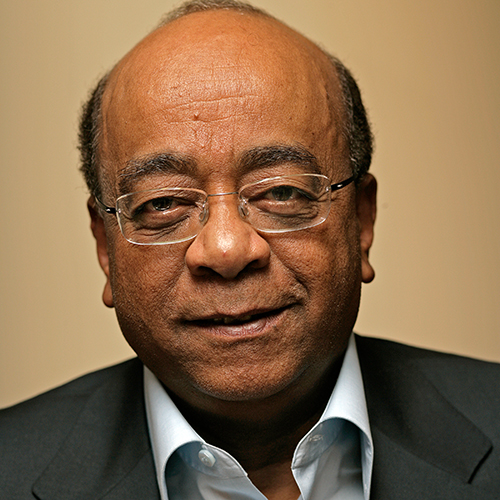
AFRICA’S MONEY LIST 25 – The Architects of Economic Power
Mo Ibrahim : The Architecture of Accountability Capital
In the hierarchy of global wealth, there exists a category of figures whose influence is not measured by what they own, but by what they reshape. Their capital does not merely extract value from systems—it attempts to correct them.
Mo Ibrahim belongs to that category.
Where most fortunes are built on controlling assets, his was built on connecting absence—specifically, the absence of telecommunications infrastructure across Africa in the late 20th century. But unlike many who stop at wealth creation, Ibrahim redirected his capital toward something less tangible and far more difficult to engineer: governance itself.
Infrastructure Before Institutions
Before governance became his defining arena, Ibrahim operated in a space more familiar to traditional capital—telecommunications. Through Celtel, he entered markets often dismissed as commercially unviable, building mobile networks across multiple African countries at a time when connectivity was fragmented or nonexistent.
This was not simply a business expansion strategy. It was a structural intervention.
Telecommunications, like cement or energy, sits beneath visibility. It enables coordination, markets, finance, and information flow. Without it, modern economies do not scale.
By solving connectivity at scale, Ibrahim positioned himself within the pre-institutional layer of economic growth—the stage at which systems become possible before they become efficient.
The Exit That Redefined the Model
In conventional capital cycles, exit marks the end of involvement. For Ibrahim, it marked a shift in function.
The sale of Celtel was not followed by reinvestment into parallel industries or expansion into adjacent markets. Instead, it redirected capital toward governance—a domain where returns are neither immediate nor easily quantifiable.
This transition is what separates Ibrahim from traditional industrialists.
He moved from building infrastructure within markets to influencing the conditions under which markets operate.
Governance as a Form of Capital Deployment
Through the Mo Ibrahim Foundation, his work enters a different register—one that operates at the intersection of economics, politics, and long-term state performance.
The Ibrahim Index of African Governance does not generate revenue. It generates measurement.
The Ibrahim Prize for Achievement in African Leadership does not scale like a business. It sets a benchmark.
This is capital functioning not as accumulation, but as calibration.
In this model, wealth is deployed to shape incentives:
- rewarding leadership transitions
- quantifying governance performance
- introducing reputational stakes into political systems
It is a form of influence that bypasses markets entirely and engages directly with state behaviour.
Power Without Ownership
Unlike many figures on Africa’s Money List, Ibrahim’s current influence is not anchored in dominant shareholdings or industrial control. It is anchored in standards.
He does not control supply chains.
He does not dictate commodity pricing.
He does not operate large-scale production assets.
Instead, he operates in a space that precedes all of those: the quality of governance that determines whether such systems function effectively at all.
This places him in a unique category of power—one that is diffuse, difficult to quantify, and resistant to replication.
Capital Beyond Markets
Modern wealth typically compounds through reinvestment into scalable systems—technology, finance, energy, consumer markets. Ibrahim’s model diverges.
His capital moves toward non-market outcomes:
- institutional trust
- leadership accountability
- policy transparency
These are not sectors. They are conditions.
And without them, even the most sophisticated economic systems degrade over time.
In this sense, his work operates upstream from traditional capitalism. It addresses the variables that determine whether capital can function efficiently in the first place.
Position Within Africa’s Money List
Within the framework of Africa’s Money List, Mo Ibrahim occupies a distinct classification: governance capital.
His relevance is not derived from controlling industries, but from attempting to influence the rules by which those industries—and the states that host them—are governed.
While others build within systems, Ibrahim focuses on the systems themselves.
Conclusion: The Economics of Accountability
The clearest way to understand Mo Ibrahim is through redirection.
He built wealth by enabling connection.
He deploys it by enforcing accountability.
In most economic narratives, capital seeks efficiency, scale, and return.
In his case, it seeks stability, integrity, and continuity.
That distinction places him outside conventional rankings.
Not because he lacks scale—but because his influence operates on a different axis.
Africa does not experience his impact through products or pricing.
It encounters it through expectations.
And over time, expectations shape systems just as powerfully as capital itself.