There’s a quiet revolution happening across African music and it doesn’t announce itself with noise. It moves through feeling, through texture, through voices that sound like they’ve always belonged, even when the industry didn’t make space for them.
For years, the narrative around African music particularly Afrobeats has been dominated by a narrow lens. But that lens is widening. Across Lagos, Accra, Johannesburg, Nairobi, and beyond, a generation of female artists is stepping forward with clarity, control, and a refusal to be reduced.
They’re not just participating in the culture. They’re reshaping its direction.
This is not a moment. It’s a movement.
Ayra Starr (Nigeria)
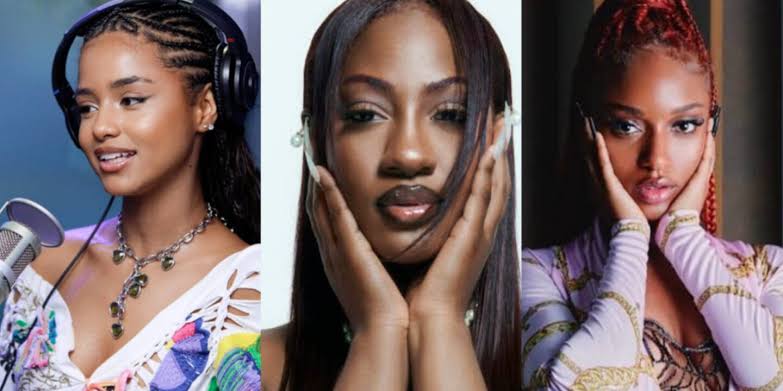
Ayra Starr moves with the confidence of someone who understands both timing and identity. Since her breakout under Mavin Records, she has become one of the defining faces of the new Afrobeats generation balancing chart success with a strong sense of self.
Her music exists at the intersection of youth and intention. Tracks like Rush and Bloody Samaritan don’t just resonate because they’re catchy, they carry attitude, vulnerability, and a clear voice. Ayra doesn’t shrink herself to fit expectations; she expands the frame.
What makes her compelling isn’t just her consistency it’s her range. She can deliver high-energy anthems and pivot seamlessly into more introspective territory, all while maintaining a cohesive identity. In an industry that often demands speed, Ayra is building something more durable: a long-term presence.
Tyla (South Africa)
Tyla represents a new kind of crossover, one that doesn’t dilute origin for global appeal. Instead, she leans into it.
Her sound, often rooted in amapiano, flows naturally into pop and R&B spaces, creating something that feels both local and international. With breakout records that travel across continents, Tyla has positioned herself as one of the most export-ready artists of her generation.
But beyond the music, there’s precision. Her visuals, choreography, and branding are tightly controlled, signaling an artist who understands the full scope of modern stardom. She isn’t just releasing songs she’s crafting moments.
And those moments are scaling fast.
Tems (Nigeria)
Tems operates on a different frequency entirely.
Her voice raw, textured, almost meditative cuts through noise with ease. From early breakout records to global collaborations, she has built a catalog that feels intentional at every step. There’s a spiritual undertone to her music, a sense that it’s coming from somewhere deeper than trend cycles.
What sets Tems apart is restraint. She doesn’t oversaturate. She doesn’t chase visibility. And yet, when she appears, it matters.
Her rise from Lagos to global stages and award platforms has been both organic and strategic. She has become a bridge between African music and the wider world, not by adapting, but by remaining fully herself.
Amaarae (Ghana)
If there’s an artist who embodies fluidity, it’s Amaarae.
Genre, for her, is more of a suggestion than a rule. Her music pulls from alté, pop, electronic, and Afro-fusion, creating a sound that feels constantly in motion. But it’s not just about sound, it’s about aesthetic coherence.
Amaarae’s world is fully realized. From visuals to sonic choices, everything aligns. She doesn’t just release music; she builds universes around it. And in doing so, she’s helped push African alternative music further into global consciousness.
She’s not following trends. She’s setting them quietly, but effectively.
Qing Madi (Nigeria)
There’s something disarming about Qing Madi’s music.
It doesn’t shout. It doesn’t rush. It invites.
Her sound leans into softness gentle melodies, reflective lyrics, and a delivery that feels intimate without being fragile. In a landscape often driven by high energy, Qing Madi’s restraint becomes her strength.
She represents a different kind of growth one that builds slowly but sticks. Her audience isn’t just listening; they’re connecting.
And that connection is what travels.
Bloody Civilian (Nigeria)
Where others refine, Bloody Civilian disrupts.
Her sound is layered, cinematic, and often unpredictable. There’s an edge to her work, a willingness to experiment, to challenge structure, to push against expectations. Whether through bold production or unconventional songwriting, she creates music that feels alive and slightly chaotic in the best way.
She’s part of a new class of artists who see music as more than sound as experience, as narrative, as statement.
And that approach is opening doors far beyond traditional spaces.
Gyakie (Ghana)
Gyakie’s strength lies in her emotional clarity.
Her music, rooted in Afro-fusion and R&B, carries a warmth that feels immediate and accessible. But beneath that accessibility is discipline a careful approach to growth that prioritizes longevity over quick wins.
She’s not rushing the process. She’s building it.
With each release, Gyakie sharpens her identity, creating a body of work that feels cohesive and intentional. In a fast-moving industry, that kind of patience is rare and powerful.
Fave (Nigeria)
Fave proves that you don’t have to be loud to be heard.
Her music is minimal but effective clean production, sharp lyrics, and a delivery that feels effortless. There’s a quiet confidence in her approach, one that draws listeners in rather than demanding attention.
She’s part of a wave that values substance over spectacle, and it shows in how her music lingers.
Fave’s rise might not be explosive, but it’s steady and often, that’s what lasts.
Nikita Kering (Kenya)
From East Africa, Nikita Kering brings a level of vocal control and emotional depth that feels globally competitive.
Her sound blends R&B with Afro-fusion, but what truly stands out is her ability to convey feeling with precision. Every note feels intentional, every performance measured.
She represents a growing presence of East African artists in the global conversation artists who are no longer peripheral, but central to the future of African music.
More Than Representation – A Redefinition
What connects these nine artists isn’t just gender. It’s agency.
They are:
- Owning their narratives
- Controlling their aesthetics
- Expanding their reach beyond traditional borders
For a long time, female artists in African music were underrepresented, often sidelined in favor of male-dominated narratives. That reality is shifting, not just because there are more women, but because they’re arriving with vision and leverage.
They understand the modern industry:
- Streaming as distribution
- Social media as storytelling
- Image as extension of sound
And they’re using all of it.
The Future Is Already Taking Shape
In the next few years, the conversation around African music will continue to evolve. New stars will emerge, sounds will shift, and global attention will deepen.
But one thing is already clear:
The future will not look like the past.
It will be more diverse. More expressive. More intentional.
And at the center of it, voices like these won’t just be included they’ll be defining the direction.
This isn’t just a new chapter.