
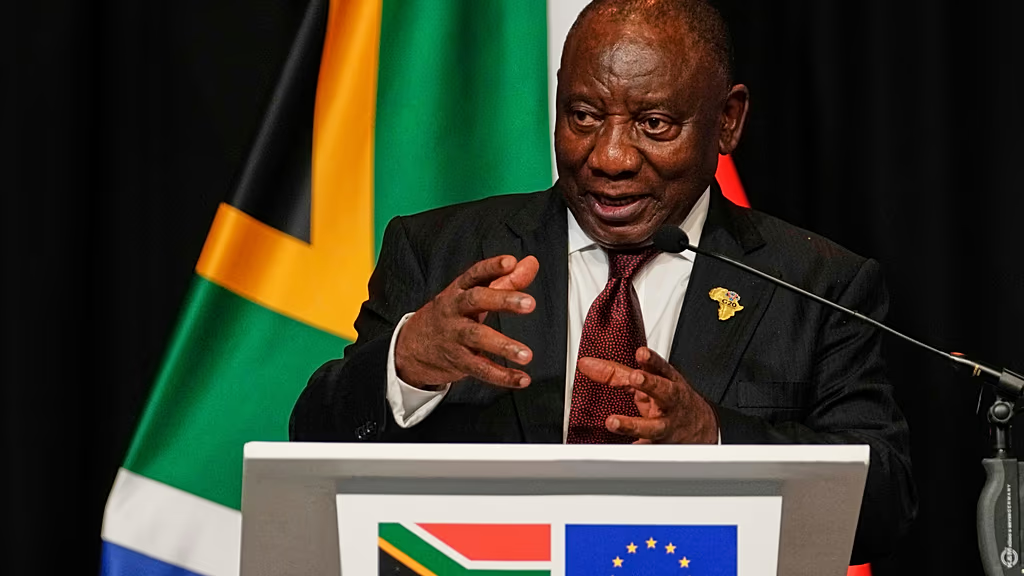
In a closely watched trilateral summit on Thursday, South African President Cyril Ramaphosa joined European Commission President Ursula von der Leyen and European Council President António Costa to reaffirm what all three leaders described as a rapidly maturing strategic partnership. The meeting, held against a backdrop of shifting geopolitical alliances and intensifying competition for the world’s most valuable minerals, produced a series of commitments aimed at deepening economic cooperation, strengthening clean-energy transitions, and reinforcing multilateral governance.
“It has indeed been a real honour to jointly preside over the South Africa–EU leaders’ trilateral meeting,” Ramaphosa said, striking a confident tone. “We’ve characterised this relationship as a mature relationship — one that is predictable, reliable, and based on trust.”
A landmark minerals agreement
At the heart of the summit was the signing of a far-reaching agreement on critical minerals — the metals essential for renewable power, electric-vehicle batteries, advanced digital technologies and strategic defence systems. The pact seeks to move both South Africa and the EU further up the value chain at a moment when global demand for these resources is soaring and concerns over supply disruptions are reshaping industrial policy across continents.
For the EU, which has been scrambling to diversify away from heavily concentrated mineral supply routes, the agreement offers a vital hedge. For South Africa, it positions the country not merely as an exporter of raw materials but as an emerging hub for processing, refining and advanced manufacturing.
Von der Leyen emphasised the scale of the EU’s commitment: “Today we’ve signed three new major projects. We are investing €350 million to modernise South Africa’s infrastructure, both in transport and energy. This includes support for Transnet’s decarbonisation under the Just Energy Transition Partnership.”
Key priorities outlined at the summit
• Building domestic value in South Africa
The South African government made clear it does not intend to remain a supplier of unprocessed minerals. Instead, Pretoria aims to expand domestic processing, stimulate industrial growth, and create higher-value jobs linked to the green and digital economies.
• Strengthening clean-energy and transport infrastructure
The EU’s Global Gateway investment strategy will underpin projects to upgrade rail, port and energy systems — support that European leaders say is essential to unlocking long-term trade and investment flows.
• Defending multilateralism amid global uncertainty
Both sides underscored the urgency of protecting multilateral institutions at a time when U.S. engagement in global forums remains unpredictable. The agreement signals an intention to uphold a rules-based international order and to collaborate on global challenges ranging from climate change to trade governance.
Why it matters for Business Africa
For South Africa, the deal represents a significant step toward broadening its industrial base and capturing more of the value generated by its vast mineral endowment. It opens the door for new investment in processing facilities, technology partnerships and skills development — all essential for shaping a more resilient, diversified economy.
For the EU, the partnership enhances security of supply for critical inputs needed to meet ambitious clean-tech and emissions-reduction goals. It also illustrates a new model of cooperation with African partners: one that moves beyond traditional donor-recipient dynamics and toward co-investment and joint industrial development.
Ramaphosa welcomed this evolution: “We are very pleased to have a partner like the EU, with whom we can discuss a variety of matters — just this year alone.”
A new chapter in Africa–Europe cooperation
Analysts say the agreement reflects a convergence of priorities: Africa’s long-standing ambition to industrialise and Europe’s urgency to secure strategic resources. The result is a partnership that could reshape supply chains, redefine diplomatic relations and offer a blueprint for future North–South collaboration.
If successfully implemented, the South Africa-EU mineral and infrastructure accords may well mark the beginning of a more equitable and strategically aligned phase in Africa–Europe relations — one rooted in shared interests and mutual economic gain.
Leave a Reply