
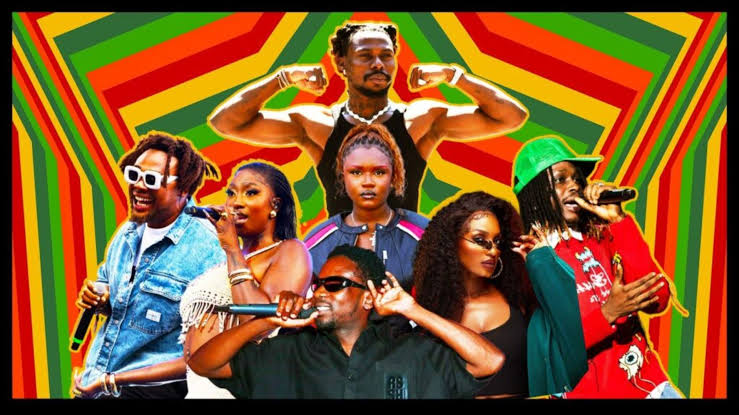
The tension between old school and new school isn’t new. Every era of music has felt it the quiet resistance, the debates over authenticity, the question of who’s carrying the culture forward and who’s redefining it. But in African music right now, that tension feels less like a divide and more like a conversation.
Because for the first time in a long time, both sides are listening.
The old guard built the foundation. Long before streaming numbers and global tours, there were artists shaping sound through Highlife, Fuji, Juju, Soukous genres rooted in tradition, storytelling, and live instrumentation. Their music wasn’t just entertainment; it was documentation. Of history, of struggle, of identity. The stage was sacred, the band was central, and the message mattered as much as the melody.
Then came the new wave.
Digital, fast-moving, globally aware. Afrobeats, Amapiano, Afro-fusion sounds born as much from local streets as from internet culture. The new school grew up with access: to software, to global influences, to audiences far beyond their immediate environment. They didn’t have to wait for the world to discover them they could upload and be heard instantly.
At first, the gap between the two felt wide.
Veterans questioned the substance of the new sound its reliance on vibes over depth, its shift away from live instrumentation, its embrace of trends. The new school, in turn, saw the old guard as gatekeepers respected, but sometimes resistant to change.
But something shifted.
Not abruptly, but gradually. Collaboration replaced criticism. Influence became mutual.
You started to hear it in the music. Younger artists sampling or reinterpreting older sounds, weaving Highlife guitars into Afrobeats rhythms, borrowing melodic structures that had been around for decades. At the same time, veterans began to adapt experimenting with modern production, appearing on contemporary records, stepping into spaces they once stood outside of.
The bridge wasn’t built through statements.
It was built through records.
And then through moments.
A legend sharing a stage with a rising star. A remix that pairs generations. A co-sign that feels less like approval and more like alignment. These moments carry weight because they signal continuity that the culture isn’t being replaced, it’s being extended.
There’s also a deeper understanding forming beneath it all.
The new school isn’t disconnected from tradition they’re products of it. Even when the sound feels modern, the roots are there: in rhythm, in language, in storytelling. What’s changed isn’t the foundation, it’s the delivery.
And the old guard is starting to see that.
At the same time, younger artists are beginning to recognize the value of legacy not just as history, but as leverage. There’s a certain weight that comes from understanding where the sound came from, from knowing the shoulders you’re standing on. It adds depth. It adds perspective.
That exchange is reshaping the culture.
Because instead of a clean break between generations, what’s emerging is a continuum, a fluid line where past and present coexist. One informs the other. One challenges the other. And in that tension, the music evolves.
It also strengthens the global narrative.
As African music continues to expand internationally, that sense of continuity becomes an asset. It tells a fuller story one that doesn’t just highlight what’s new, but what’s enduring. It shows that this isn’t a trend born in the moment, but a movement built over time.
And that matters in a global industry that often prioritizes the next over the now.
Still, the balance isn’t perfect.
There are still disagreements. Still questions about direction, about ownership, about how the culture should be represented on the world stage. But those conversations are part of the process. They’re signs of a culture that’s active, evolving, and engaged with itself.
What’s clear is this:
The gap is closing.
Not because one side is winning, but because both are adapting.
The old guard is finding new ways to stay present.
The new wave is finding deeper ways to stay rooted.
And somewhere in between, African music is doing what it’s always done best absorbing, transforming, and moving forward without losing where it came from.
This isn’t a clash of generations.
It’s a collaboration in real time.