
As record heat waves and worsening water scarcity strain the region, experts are warning that North Africa must rapidly diversify its energy mix to avoid deepening dependence on fossil fuels and economic vulnerability.
Over the past two decades, electricity use across the Middle East and North Africa (MENA) has tripled, increasing by more than 1,000 terawatt-hours—a rise surpassed only by China and India. The International Energy Agency (IEA) forecasts that regional demand will climb another 50% by 2035, equivalent to adding the combined electricity use of Germany and Spain.
If current trends persist, meeting that demand could require burning 2.8 million barrels of oil and 500 billion cubic metres of gas annually — an unsustainable trajectory, according to energy analysts.
“The projection is alarming for North Africa,” warns Abdelaziz Khlaifat, chair of petroleum and energy engineering at the American University in Cairo (AUC). “Relying on more gas will divert export earnings, inflate subsidies, and entrench carbon-intensive systems just as global markets are pivoting to renewables. It’s a short-term fix that risks long-term fragility.”
Rising risks and growing opportunities
Natural gas and oil already supply nearly 90% of North Africa’s electricity, a share that exposes the region to price shocks and fiscal stress. Yet the IEA’s latest Electricity in MENA report also highlights the immense potential for a clean-energy transition.
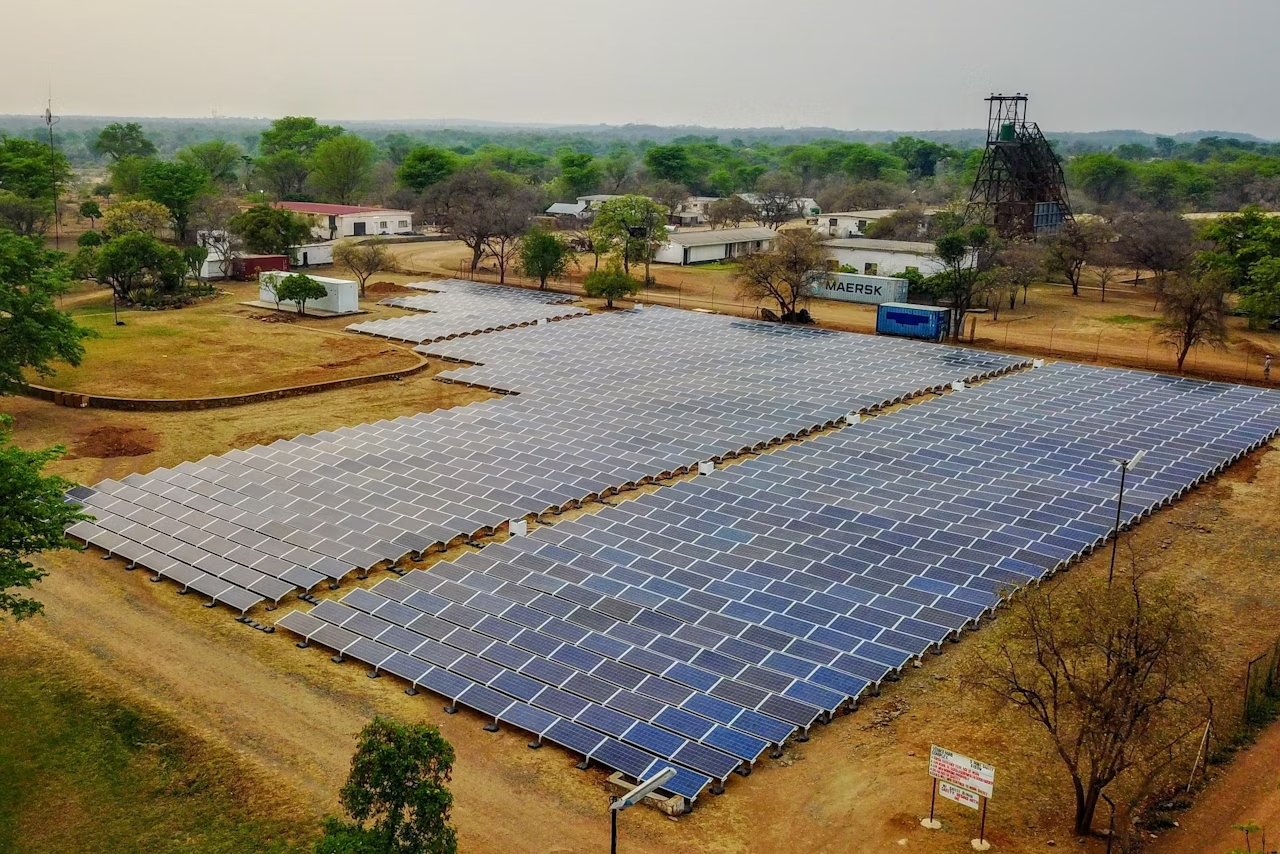
In 2024 alone, the region attracted over $44 billion in renewable-energy investment — among the highest levels in the developing world — and that figure is projected to rise by nearly 50% by 2035. With some of the planet’s strongest solar irradiation and expanding grid infrastructure, North Africa could emerge as a renewable powerhouse.
“This is not a zero-sum game between gas and renewables,” says Ali Saffar, head of the IEA’s division for Europe, the Middle East, Africa and Latin America. “Gas will remain part of the mix, but solar is expected to grow from around 5% today to roughly a quarter of total capacity. The goal is diversification, not elimination.”
The IEA’s World Energy Outlook 2024 underscores that successful transitions in emerging economies hinge on maximizing the efficiency of existing assets — including gas infrastructure — while aggressively scaling up renewables and improving transmission networks.
Balancing grids and water security
As climate change intensifies, electricity is becoming essential not only for cooling but also for water production. Across the MENA region, cooling accounts for as much as 70% of peak summer demand, while desalination consumes about 5% of total power, a share expected to double by 2040.
To meet these dual challenges, countries are increasingly adopting reverse osmosis — a technology powered by electricity rather than fossil fuels — to replace older, energy-hungry thermal desalination plants.
“Reverse osmosis is roughly ten times more energy-efficient,” says Saffar. “And because it runs purely on electricity, it can be powered by renewables. Since 2018, all new desalination capacity in the region has been electricity-based — perfectly aligned with solar expansion.”
Morocco, for example, now mandates that new desalination facilities be powered entirely by renewables. The plan to produce 1.7 billion cubic metres of desalinated water annually by 2030 — with clean energy at its core — is seen as a model for integrated water-energy management.
“It’s a critical test case,” explains Jauad El Kharraz, executive director of the Water-Energy-Climate Experts Network (WECEN). “Projects like TERAMED, which targets one terawatt of Mediterranean renewables by 2030, show what regional cooperation can achieve.”
Diverging national strategies
Each North African country is charting its own path. Morocco, long regarded as a clean-energy leader, aims for 52% renewable capacity by 2030 and already reached 38% by 2023. Its flagship Noor Ouarzazate Solar Complex, the world’s largest concentrated solar plant, powers more than a million homes. Wind projects exceeding 2.3 GW are online, with another 2.6 GW under development.
“Morocco’s success shows how political will, clear targets, and strong partnerships can accelerate the transition,” says El Kharraz. “Flagship projects attract capital; public-private partnerships and regional cooperation help scale ambition.”
By contrast, Algeria remains tethered to hydrocarbons, with renewables supplying barely 1% of its electricity despite enormous solar potential and a stated goal of 22 GW of renewable capacity by 2030. Tunisia has set a 30% renewable target but continues to rely heavily on imported gas.
Egypt sits between these extremes — ambitious but uneven. Its Benban Solar Park (1.8 GW) is among the world’s largest, and the El-Dabaa nuclear project represents a broader diversification push. With strong wind potential along the Gulf of Suez, Egypt could become a regional power hub. But grid constraints, policy uncertainty, and funding gaps remain obstacles.
“Egypt’s challenge is maintaining policy consistency and mobilising private investment,” says AUC’s Khlaifat. “Progress is visible, but the pace must quicken.”
From vulnerability to advantage
The IEA argues that the region’s looming demand surge should be viewed as a call to innovate, not panic. With vast solar and wind resources, emerging green-hydrogen projects, and new interconnection plans, North Africa can meet its own needs while becoming a hub for cross-continental power trade.
The Natural Resource Governance Institute (NRGI) calls EU-North Africa partnerships a “win-win” for energy security, investment, and development, while the African Continental Free Trade Area (AfCFTA) could facilitate new south-south energy corridors, connecting Morocco to West Africa via Mauritania.
Still, experts urge caution against prioritising exports over domestic stability.
“It’s premature to talk about large-scale power exports when local industries remain underdeveloped and households face shortages,” warns Saffar. “Ensuring reliable, affordable domestic electricity must come first.”
With youth unemployment above 22%, reliable power is not just an energy issue — it’s an economic one. Expanding access to clean, affordable electricity will be crucial for attracting manufacturing, enabling industrial growth, and creating jobs.
“Commodity exports alone won’t generate enough value,” Saffar adds. “The real opportunity lies in using renewable energy to build low-carbon industries that keep wealth and jobs within the region.”
A defining decade ahead
As North Africa races to meet surging energy demand, it stands at a pivotal moment. Managed wisely, the coming decade could transform the region from a fossil-fuel supplier into a global model for clean, inclusive industrialisation.
The challenge is not whether North Africa can produce enough renewable power — it’s whether it can harness that energy to power its own future before sending it abroad.

Leave a Reply