
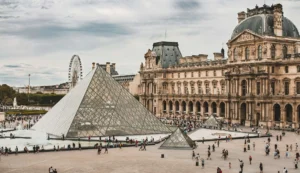
On an ordinary Sunday morning, the world’s most visited museum became the scene of an extraordinary crime. In just four minutes, a group of masked thieves stormed the Louvre in Paris and vanished with priceless royal jewelry, leaving behind shattered glass, stunned guards, and a shaken sense of security.
The robbery swift, precise, and audacious felt almost cinematic. Yet unlike a film, this was a direct attack on one of humanity’s greatest storehouses of art and history. And as investigators race to recover the stolen treasures, the world is left asking: how could this happen inside the Louvre?
A Daring Daylight Heist
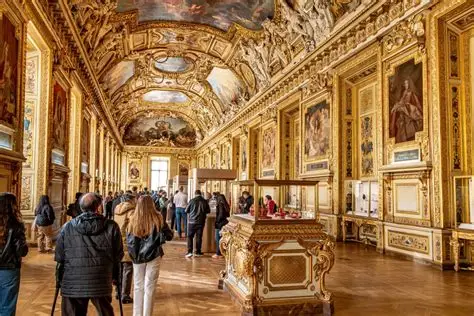
According to French police reports, the thieves struck shortly after 9 a.m. on Sunday, October 19, 2025, entering through a maintenance window in the Galerie d’Apollon, the glittering hall that once housed the French crown jewels. Armed with power tools and dressed in black, they bypassed alarms and security cameras before smashing display cases and seizing eight pieces of 19th-century jewelry, including several diamond and sapphire sets from the Napoleonic era.
The entire operation lasted less than four minutes. The thieves escaped on motorbikes waiting near the Seine, leaving behind a few scattered glass shards and an entire museum frozen in disbelief.
By the time police arrived, the culprits had vanished into Paris’s maze of narrow streets. As of this writing, none of the missing jewels have been recovered.
A Symbolic Loss
The theft wasn’t just about money. Experts estimate the jewels’ market value in the tens of millions, but their cultural worth is immeasurable. Many of the stolen items once belonged to Empress Eugénie, the last French empress and wife of Napoleon III. They represented not just opulence but history angible links to France’s royal and imperial past.
For the Louvre, this was more than a security breach; it was a symbolic wound. The Galerie d’Apollon, named after the Greek god of light, has long stood as a testament to French artistic mastery. That light dimmed, if only metaphorically, when thieves turned one of its proudest spaces into a crime scene.
A Question of Security
The Louvre has always been seen as an impregnable fortress of art. Home to over 35,000 works, including the Mona Lisa and the Venus de Milo, it welcomes nearly 10 million visitors each year. Yet behind that prestige, insiders have long warned about understaffing, outdated surveillance systems, and budget pressures.
In 2019, the museum suffered a smaller attempted break-in, and earlier this year, French unions complained about cuts to night-shift security. This latest heist seems to confirm their fears. How could a handful of thieves bypass alarms, shatter reinforced glass, and flee within minutes from a site under 24-hour surveillance?
Authorities are now investigating whether the robbers had inside knowledge. According to reports from Le Monde and AP News, police suspect the thieves exploited a blind spot in the museum’s security grid, entering through a section undergoing renovation.
The Louvre closed its doors the following day for a full audit. French Culture Minister Rachida Dati called the theft “a national embarrassment” and vowed to strengthen museum security nationwide.
The Spectacle of Art Theft
There’s something both horrifying and fascinating about art heists. They sit at the crossroads of crime and culture acts of destruction disguised as feats of audacity. From the 1990 Isabella Stewart Gardner Museum robbery in Boston to the 2025 Paris heist, these crimes remind us that cultural heritage, however sacred, is never beyond reach.
What’s striking about the Louvre theft is its brevity and boldness. It wasn’t a shadowy operation carried out under cover of night. It was a precision-timed strike in daylight, pulled off in the heart of one of the world’s most surveilled cities.
It’s easy to imagine this scene unfolding like a Mission: Impossible sequence the buzzing tools, the glass breaking, the silent dash down marble corridors. But strip away the cinematic sheen, and what remains is loss: eight irreplaceable artifacts that belong not to a collector, but to the public.
A Global Wake-Up Call
Museums worldwide are now on alert. The Louvre’s heist underscores a simple truth even institutions built to protect the past are vulnerable to modern methods of crime. As security systems grow more digital, they also grow more hackable; as visitor numbers rise, human oversight thins.
Curators and cultural ministers across Europe have already begun reassessing security frameworks, from London’s British Museum to Madrid’s Prado. The fear is not just of theft, but of copycat crimes, inspired by the success and spectacle of the Louvre robbery.
For France, the heist has reignited a national debate over funding for cultural institutions. Many argue that heritage preservation has been under-prioritized in favor of tourism and events. The Louvre’s robbery, they say, should serve as a turning point, a reminder that protecting art isn’t merely about guarding property, but safeguarding identity.
Beyond the Glass
Standing before the empty display case now roped off in the Galerie d’Apollon, visitors describe a strange silence part disbelief, part mourning. The absence itself has become an exhibit, a reminder of fragility in a place meant to feel eternal.
There’s irony in that image: the Louvre, designed to immortalize art, now testifying to how quickly even history can vanish.
The museum will eventually recover, perhaps even the jewels will resurface. But the greater loss lies in trust the quiet assumption that the treasures of civilization are safe behind glass and marble.
A Four-Minute Lesson
In the end, the Louvre heist wasn’t just a theft; it was a mirror held up to the world’s museums. It exposed the tension between openness and security, between sharing art and protecting it.
Four minutes were all it took to shake the confidence of a global cultural institution. The challenge now is whether those four minutes can inspire something longer lasting: reform, vigilance, and renewed respect for the value of what we stand to lose.

Leave a Reply