
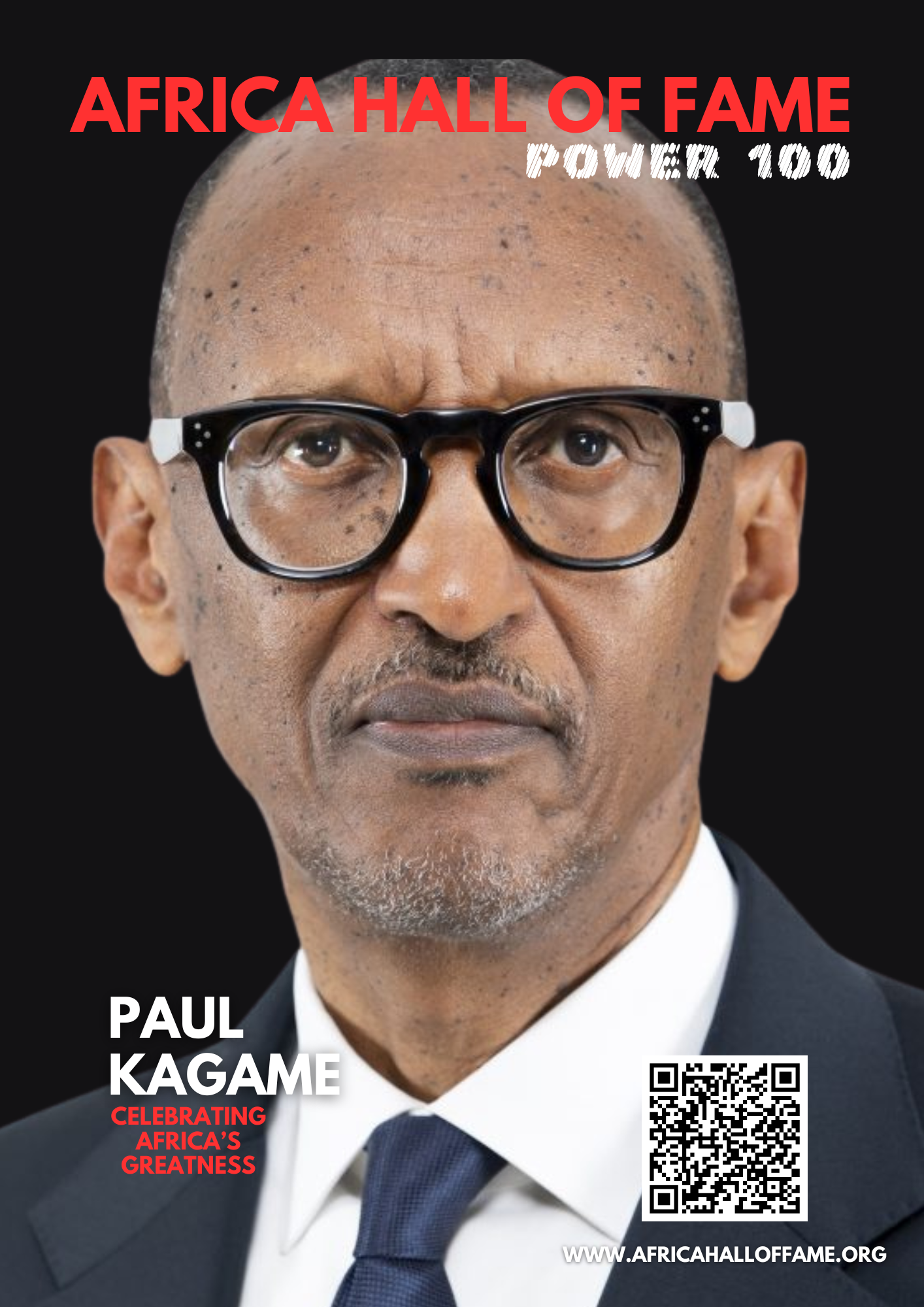
Africa Hall of Fame: Power 100
Paul Kagame: The Power of Statecraft and Strategic Transformation
A Different Kind of Power
Paul Kagame represents a form of power rooted in statecraft, discipline, and long-term national transformation. His influence is not built on inherited wealth or corporate empires, but on rebuilding institutions, enforcing stability, and redefining the trajectory of a nation.
In the modern era, political power is measured not only by authority, but by the ability to create order, drive development, and reposition a country within global systems. Kagame’s strength lies in shaping governance structures and using them as instruments of economic and social change.
His power is grounded in leadership—specifically, the capacity to direct national recovery and strategic growth.
From Conflict to Control
Kagame emerged as a central figure in the aftermath of the Rwandan Genocide—one of the most devastating tragedies in modern African history. As a leader of the Rwandan Patriotic Front, he played a decisive role in ending the violence and establishing a new political order.
The challenge that followed was immense: rebuilding a fractured nation, restoring security, and reconstructing institutions from near collapse.
Where many post-conflict states struggle with instability for decades, Rwanda pursued rapid centralisation, disciplined governance, and strict administrative control. Kagame positioned stability as the foundation of national progress.
Power, in this context, meant control—over security, over institutions, and over the direction of reform.
Engineering a Development Model
Under Kagame’s leadership, Rwanda has pursued an ambitious development agenda focused on infrastructure, technology, and services. Kigali has been positioned as a conference hub, a financial centre, and a symbol of urban order.
The strategy has been deliberate: attract investment, promote efficiency, reduce corruption, and create a business-friendly environment. Rwanda consistently ranks among Africa’s most administratively streamlined economies.
This reflects a governance model built on performance metrics and institutional discipline. Ministries operate with defined targets. Public officials are held to measurable outcomes.
Kagame’s approach treats the state not as a loose political coalition, but as an operational system designed to deliver results.
Stability as Strategic Capital
One of Kagame’s defining beliefs is that security precedes prosperity. By prioritising law enforcement, national unity, and centralized authority, he has sought to prevent the fragmentation that undermines many developing states.
This has made Rwanda one of the safest and most orderly countries in the region. Stability has, in turn, become an economic asset—encouraging tourism, foreign investment, and global partnerships.
Critics have questioned aspects of political openness, but supporters argue that the model has delivered measurable gains in healthcare, education, and economic growth.
Regardless of perspective, Kagame’s influence is undeniable: he has reshaped Rwanda’s global image from a symbol of tragedy to one of recovery and ambition.
Global Diplomatic Reach
Kagame’s power extends beyond Rwanda’s borders. He has served as Chairperson of the African Union and has positioned himself as a voice in continental reform discussions.
His advocacy for African self-reliance, institutional reform, and regional integration reflects a broader strategic outlook. He promotes an Africa that finances its own institutions, negotiates from strength, and builds internal capacity.
Through diplomacy, security partnerships, and economic alliances, Kagame has cultivated influence that reaches into regional and global forums.
He operates not only as a national leader, but as a continental strategist.
Discipline, Image, and National Branding
Kagame understands the power of perception. Rwanda’s clean streets, technology conferences, and global events are part of a deliberate branding effort—projecting competence, order, and modernity.
National image becomes strategic capital.
Under his leadership, Rwanda has invested in aviation, tourism, and international partnerships, positioning itself as a gateway between Africa and global markets.
The result is a country whose size is small, but whose visibility is disproportionately large.
A Model of Centralised Authority
Kagame represents a model of power built on centralised authority and strategic clarity. Decision-making flows from a clear executive centre. National priorities are defined and pursued with discipline.
This form of leadership creates speed and coherence. Policies are implemented quickly. Large-scale initiatives move without prolonged bureaucratic delay.
It is a model that prioritises order, unity, and forward momentum.
Defining Power Through National Transformation
The Africa Hall of Fame: Power 100 recognises individuals whose influence reshapes systems. Paul Kagame embodies this principle through state-led transformation.
He did not inherit a stable system.
He constructed one.
From post-conflict reconstruction to economic repositioning, his leadership has altered Rwanda’s trajectory and expanded its global relevance.
His power is institutional.
His influence is structural.
His legacy is tied to the transformation of a nation.
For this reason, his place in the Africa Hall of Fame: Power 100 reflects a form of power rooted not in markets or commodities—but in the disciplined architecture of state leadership.