
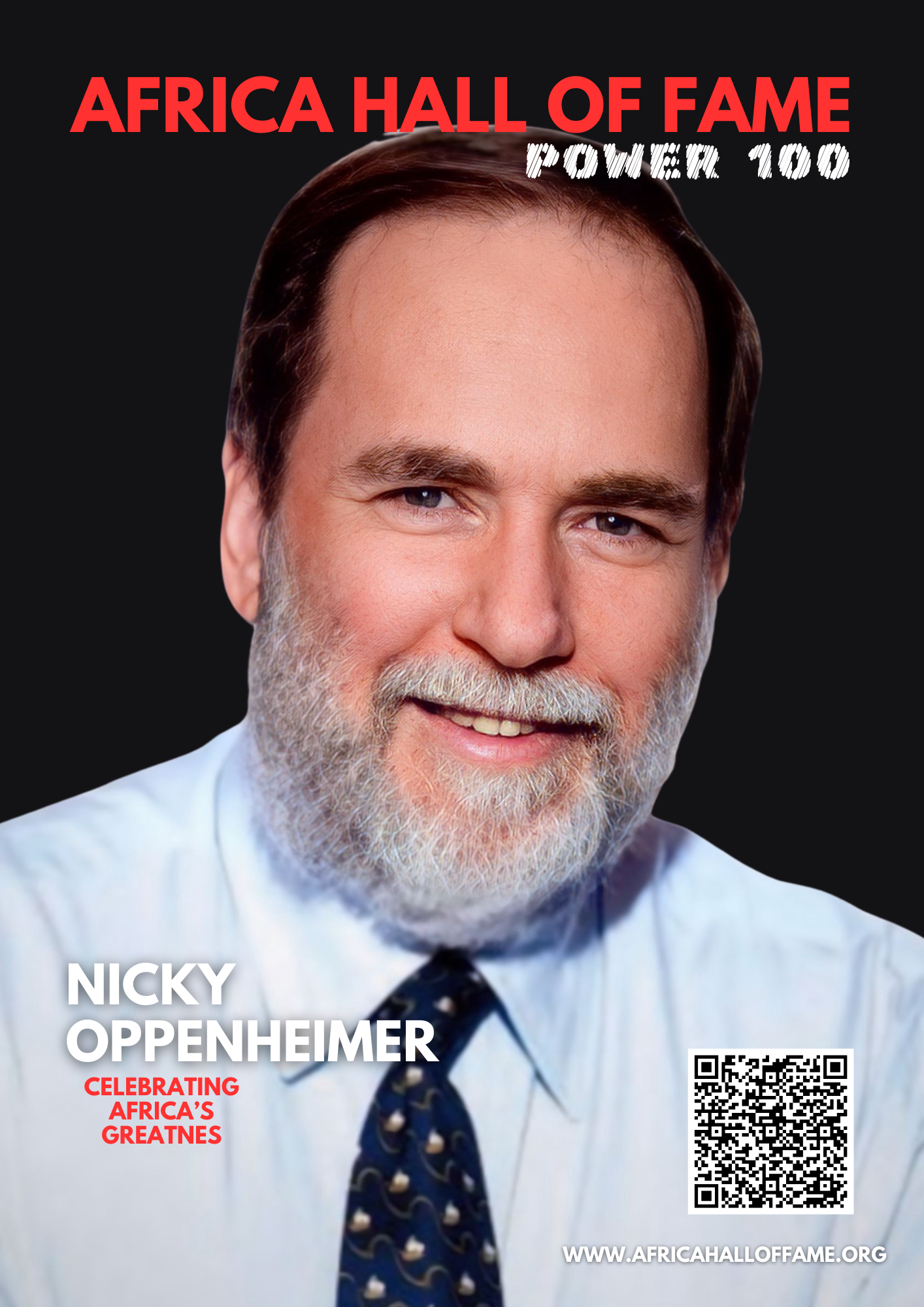
Africa Hall of Fame: Power 100
Nicky Oppenheimer: The Custodian of Africa’s Diamond Legacy (South Africa)
A Legacy of Power
Nicky Oppenheimer represents a form of power deeply rooted in legacy, natural resources, and global market control. Unlike entrepreneurs who build from scratch, Oppenheimer inherited influence—but transformed it into one of the most enduring and strategically managed fortunes in Africa.
For decades, his name was synonymous with diamonds, one of the world’s most valuable and tightly controlled commodities. Through his leadership, the Oppenheimer family maintained a dominant position in an industry that shaped economies, defined luxury, and influenced global trade.
His power lies not just in ownership, but in stewardship—the ability to manage, protect, and evolve one of Africa’s most significant natural resource empires.
⸻
Building and Controlling the Diamond Industry
At the heart of Oppenheimer’s influence was De Beers, the company that for much of the 20th and early 21st centuries controlled the global diamond supply.
As chairman, Oppenheimer oversaw a system that regulated diamond distribution, stabilised prices, and maintained the rarity and value of diamonds worldwide. De Beers was not just a mining company—it was a market-maker, shaping how diamonds were sold, marketed, and perceived.
Under his leadership, the company maintained deep operational roots across Africa, particularly in Botswana, Namibia, and South Africa, where diamond revenues became central to national economies. Through partnerships with governments, De Beers helped transform diamonds into a tool for development, funding infrastructure, education, and public services.
Few individuals have held such influence over a single global commodity. Through De Beers, Oppenheimer helped define the economics of diamonds for generations.
⸻
A Strategic Exit, A Lasting Influence
In 2012, Oppenheimer made one of the most significant decisions of his career—selling the family’s 40% stake in De Beers to Anglo American for $5.1 billion.
This move marked the end of nearly a century of Oppenheimer control over the diamond giant. But it was not a retreat—it was a strategic repositioning.
By exiting at a time of shifting global demand and increased competition, Oppenheimer preserved value while freeing capital for new investments. The decision reflected a deep understanding of market cycles and long-term risk—hallmarks of his approach to power.
Even outside of De Beers, his influence in the resource sector remains significant, with investments spanning conservation, private equity, and natural capital.
⸻
From Extraction to Conservation
What distinguishes Oppenheimer in the modern era is his shift from extraction to preservation. Through Oppenheimer Generations, he has invested heavily in conservation, sustainability, and land management across Africa.
His initiatives have focused on protecting biodiversity, supporting wildlife conservation, and promoting sustainable tourism. This evolution reflects a broader understanding of Africa’s value—not just in what can be extracted, but in what can be preserved.
In a world increasingly concerned with environmental sustainability, Oppenheimer has positioned himself at the intersection of business and conservation, using capital to protect the continent’s natural heritage.
⸻
Global Reach, African Foundations
Oppenheimer’s influence is global, but his foundation is firmly African. The diamond industry he helped shape is deeply connected to the continent, and his legacy is intertwined with the economies of multiple African nations.
His ability to operate at the intersection of African resources and global markets has made him a key figure in international business. Diamonds mined in Africa pass through global luxury markets, linking the continent to consumers worldwide.
This dual positioning—local resource control and global market influence—is a defining feature of his power.
⸻
A Quiet but Enduring Influence
Unlike many high-profile billionaires, Oppenheimer has maintained a relatively low public profile. His power operates quietly, through institutions, partnerships, and long-term investments rather than public visibility.
Yet his impact is undeniable. From shaping the global diamond trade to influencing conservation across Africa, his decisions have had lasting consequences for both markets and ecosystems.
This understated approach reinforces his authority. He is not a figure driven by attention, but by long-term impact.
⸻
Defining Power Through Resources and Stewardship
The Africa Hall of Fame: Power 100 recognises individuals whose influence reshapes industries and extends beyond wealth. Oppenheimer embodies this principle.
His legacy is not just in the billions he has accumulated, but in the systems he has helped build and the resources he has managed. From controlling one of the world’s most valuable commodities to investing in Africa’s environmental future, his influence spans both extraction and preservation.
He represents a form of power rooted in control, continuity, and strategic evolution.
For this reason, his place in the Africa Hall of Fame: Power 100 is not only justified, it is essential.
He is not just one of Africa’s richest men.
He is one of its most powerful.