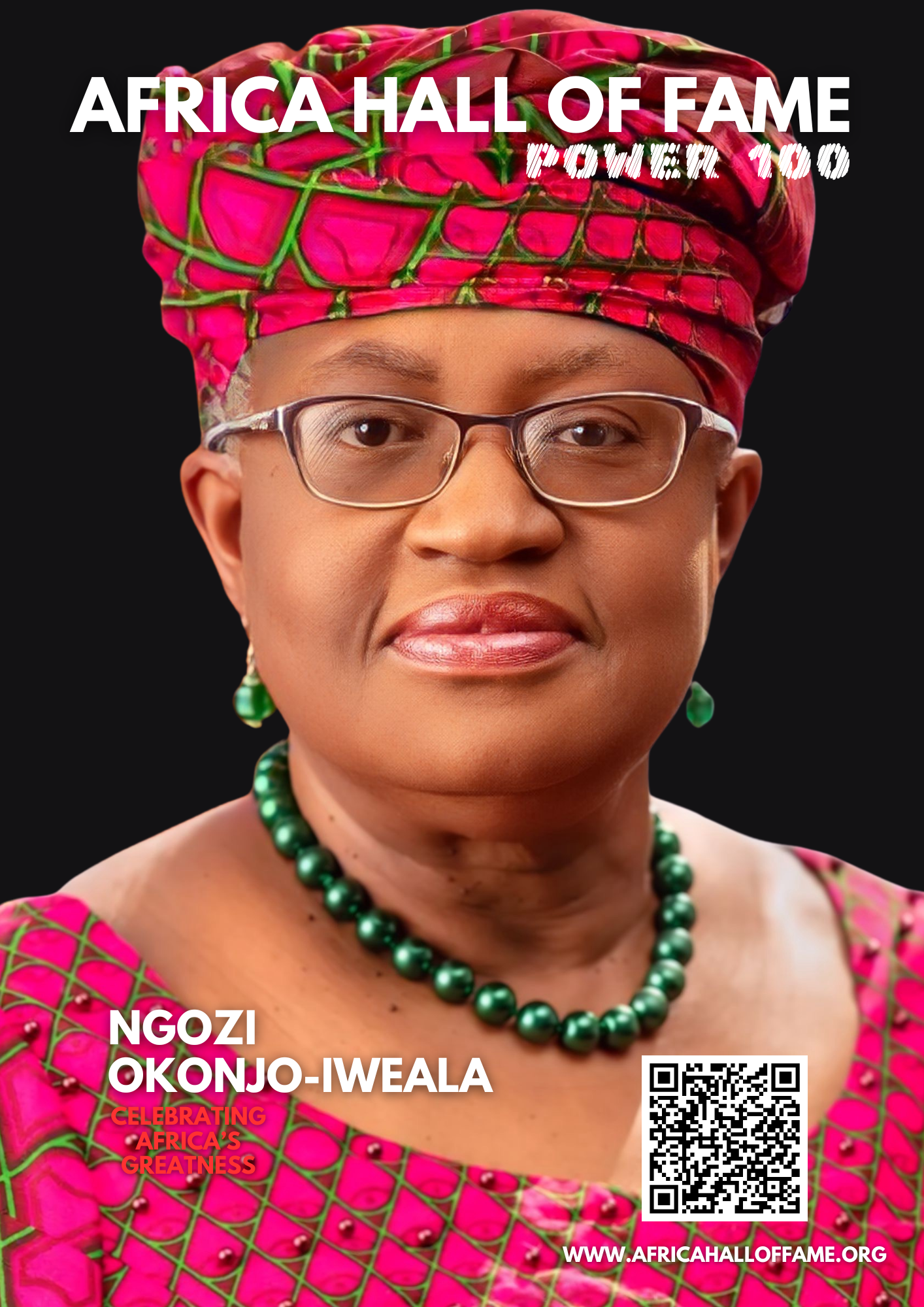

Africa Hall of Fame: Power 100
Ngozi Okonjo-Iweala: The Power of Global Economic Diplomacy
A Different Kind of Power
Ngozi Okonjo-Iweala represents a form of power rooted in economic governance, fiscal reform, and multilateral negotiation. Her influence is not built on corporate ownership or political dominance, but on shaping the rules that govern global trade and finance.
In today’s interconnected world, economic power often lies in institutions—where policies are negotiated, trade rules are written, and financial systems are stabilised. Okonjo-Iweala’s strength lies in operating at this level, where diplomacy and economics intersect.
Her power is grounded in credibility—earned through decades of financial stewardship, reform, and international leadership.
Reforming a Nation’s Finances
Okonjo-Iweala rose to prominence as Nigeria’s Finance Minister under President Olusegun Obasanjo and later under Goodluck Jonathan. In a country heavily dependent on oil revenues, she pushed for fiscal discipline, debt relief, and transparency.
One of her defining achievements was helping secure the historic debt relief deal with the Paris Club, which eliminated billions of dollars in external debt and repositioned Nigeria’s financial standing.
She championed reforms aimed at reducing corruption, strengthening public financial management, and increasing accountability in government spending.
In a system long associated with volatility, she became a symbol of technocratic competence and reform-driven leadership.
From National Reform to Global Governance
Before and after her service in Nigeria, Okonjo-Iweala built a distinguished career at the World Bank, where she served as Managing Director. There, she oversaw development portfolios spanning multiple continents, managing billions in financial commitments.
Her expertise bridged emerging markets and advanced economies—allowing her to operate fluently in both worlds.
This blend of national reform experience and global institutional leadership positioned her uniquely for a historic role.
Leading the Global Trade System
In 2021, Okonjo-Iweala became Director-General of the World Trade Organization, the first woman and the first African to lead the institution.
The WTO sits at the centre of global commerce. It governs trade rules among nations, resolves disputes, and shapes the architecture of international exchange.
Taking office during a period of trade tensions, protectionism, and post-pandemic recovery, she faced the challenge of restoring confidence in multilateral trade cooperation.
Her leadership has focused on reforming trade systems, addressing vaccine equity during the COVID-19 crisis, and modernising the institution to reflect contemporary economic realities.
At this level, power is not exercised through force—it is negotiated through consensus.
The Power of Credibility
What distinguishes Okonjo-Iweala is her reputation for integrity and competence. In global finance, credibility is currency.
Negotiations over trade, debt, and development depend on trust between nations. Her track record in fiscal reform and development finance gives her authority in rooms where global economic decisions are made.
She embodies technocratic power—the ability to influence outcomes through expertise, data, and disciplined negotiation.
This form of influence is subtle but profound. Trade agreements affect supply chains. Supply chains affect industries. Industries affect livelihoods.
By shaping the framework of global trade, she operates at the structural core of economic life.
Bridging Africa and the Global Economy
Although her work is global, her roots are firmly Nigerian. Her rise signals the growing presence of African leadership within the highest tiers of international economic governance.
She represents a bridge—between developed and developing economies, between global institutions and emerging markets, between Africa and the world.
Her leadership challenges outdated assumptions about where economic authority resides.
It also reinforces the idea that African expertise can define, not merely follow, global financial systems.
Resilience and Reform
Throughout her career, Okonjo-Iweala has confronted entrenched interests, bureaucratic resistance, and political pressure. Reform rarely comes without opposition.
Yet her approach remains consistent: fiscal discipline, transparency, institutional strength, and long-term economic stability.
She does not pursue short-term popularity.
She prioritises structural reform.
A Model of Institutional Power
Okonjo-Iweala represents a model of power built not on ownership of assets, but on stewardship of systems.
Trade rules. Debt frameworks. Development finance.
These are the invisible architectures that determine how nations prosper or struggle.
By leading and reforming these systems, she shapes the conditions under which global commerce operates.
Her influence is regulatory.
Her authority is institutional.
Her impact is international.
Defining Power Through Economic Architecture
The Africa Hall of Fame: Power 100 recognises individuals whose influence operates at the heart of global systems. Ngozi Okonjo-Iweala embodies this principle.
She has restructured national debt.
She has managed global development finance.
She now oversees the rules governing international trade.
Her power lies in shaping economic architecture—the frameworks that determine how nations grow, compete, and collaborate.
For this reason, her place in the Africa Hall of Fame: Power 100 reflects a form of power rooted not in spectacle, but in strategy, discipline, and global economic stewardship.