
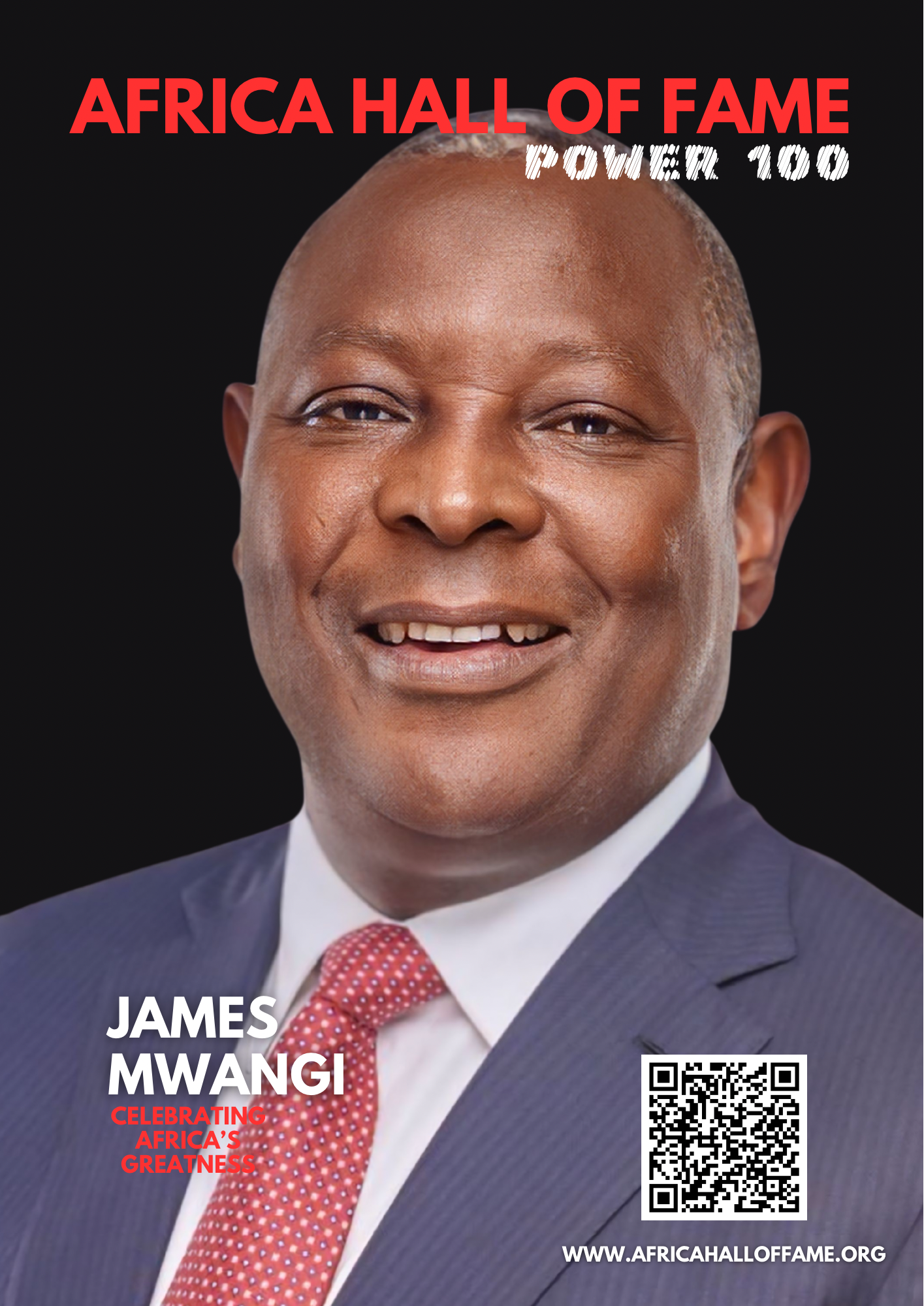
Africa Hall of Fame: Power 100
James Mwangi: The Power of Financial Inclusion
A Different Kind of Power
James Mwangi represents a form of power rooted in banking transformation, financial access, and institutional scale. His influence is not built on political office or natural resources, but on expanding access to capital—unlocking opportunity for millions who were previously excluded from formal finance.
In emerging markets, financial systems determine who can build, invest, borrow, and grow. Control over these systems is one of the most strategic levers of economic influence. Mwangi’s strength lies in redesigning banking to serve not just corporations, but households, entrepreneurs, and small businesses.
His power is grounded in access—specifically, access to financial tools that enable upward mobility.
Transforming a Bank into a Platform
At the centre of Mwangi’s influence is Equity Group Holdings. When he took leadership of what was then a struggling building society, few could have predicted its trajectory.
Under his stewardship, Equity evolved into one of Africa’s most influential banking groups, serving millions of customers across East and Central Africa.
The strategy was clear: target the unbanked and underbanked. Build trust at the grassroots level. Use scale and technology to reduce transaction costs.
Rather than focusing solely on elite corporate clients, Mwangi built a mass-market financial institution—turning inclusion into a growth engine.
Banking the Previously Excluded
One of Mwangi’s defining contributions has been expanding formal banking to low-income earners, smallholder farmers, and micro-entrepreneurs.
By simplifying account opening, lowering minimum balances, and decentralising services, Equity reshaped perceptions of who banking is for.
Access to savings accounts, microloans, and small-business financing has ripple effects:
Entrepreneurs launch enterprises.
Farmers invest in productivity.
Families finance education.
Financial inclusion becomes economic empowerment.
Mwangi recognised that millions of small transactions, aggregated at scale, create both social impact and institutional strength.
Technology as a Multiplier
Equity’s expansion coincided with East Africa’s digital revolution. Through mobile banking integration and agent networks, the bank extended its reach far beyond traditional branches.
In markets where physical infrastructure can be limited, technology became the bridge.
Mwangi’s model embraced innovation not as a trend, but as a structural advantage—lowering operational costs and increasing financial accessibility.
This positioned Equity not merely as a bank, but as a financial platform embedded in everyday economic life.
Regional Expansion and Institutional Scale
From its Kenyan base, Equity expanded into neighbouring markets including Uganda, Tanzania, Rwanda, and the Democratic Republic of the Congo.
This regional growth transformed the institution into a cross-border financial group with systemic influence in multiple economies.
Banking at this scale affects credit flows, SME growth, agricultural finance, and trade facilitation.
Mwangi’s influence therefore extends beyond corporate leadership—into the economic bloodstream of the region.
A Philosophy of Shared Prosperity
What distinguishes Mwangi is his articulation of inclusive capitalism: the belief that profitability and social impact are not opposing forces.
By serving lower-income segments profitably, Equity demonstrated that inclusion can be commercially viable.
This reframed development finance—not as charity, but as sustainable enterprise.
His leadership style blends commercial discipline with developmental awareness, creating a hybrid model that resonates across African markets.
Institutional Trust as Strategic Capital
Banking is built on trust. In many emerging economies, distrust of formal financial institutions has historically limited participation.
Mwangi understood that long-term power in finance requires credibility at the community level.
Through customer-centric policies and consistent service delivery, Equity cultivated loyalty across diverse demographic groups.
Trust, once established, becomes a powerful and compounding asset.
A Model of Financial Power
James Mwangi represents a model of wealth and influence built on financial architecture.
Accounts that hold savings.
Loans that finance expansion.
Payment systems that move capital daily.
These are the mechanisms that quietly drive economic growth.
By building and scaling such systems, Mwangi operates at a structural level—shaping who participates in the formal economy and how capital circulates.
His influence is distributive.
His authority is institutional.
His impact is regional.
Defining Power Through Inclusion
The Africa Hall of Fame: Power 100 recognises individuals whose influence transforms systems at scale. James Mwangi embodies this principle through financial inclusion and institutional expansion.
He did not simply grow a bank.
He expanded access to opportunity.
In doing so, he demonstrated that the most enduring form of financial power is not exclusion—but inclusion at scale.
For this reason, his place in the Africa Hall of Fame: Power 100 reflects a form of power rooted in widening participation, strengthening institutions, and embedding finance into the foundation of everyday economic life.