
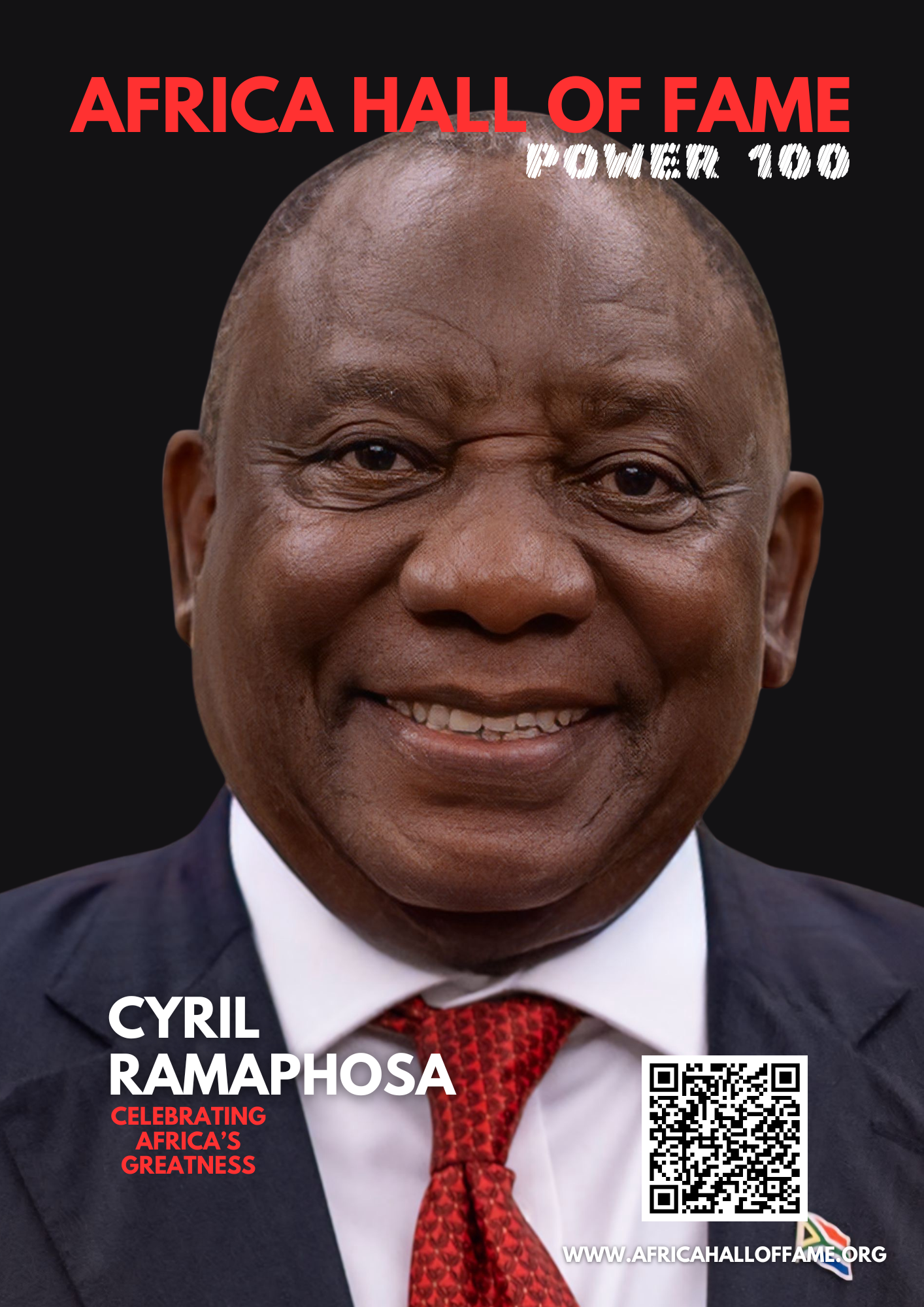
Africa Hall of Fame: Power 100
Cyril Ramaphosa: The Power of Negotiation and National Renewal
A Different Kind of Power
Cyril Ramaphosa represents a form of power rooted in negotiation, institutional reform, and economic recalibration. His influence is not built solely on political office, but on his ability to operate across spheres—liberation politics, constitutional negotiation, corporate leadership, and state governance.
In modern Africa, power often belongs to those who can bridge eras: from struggle to democracy, from activism to administration, from boardroom strategy to public accountability. Ramaphosa’s strength lies in that bridge.
His power is grounded in consensus-building—shaping outcomes through dialogue, structure, and strategic patience.
From Liberation to Constitution
Ramaphosa first rose to national prominence as a key figure in the anti-apartheid movement and a senior leader within the African National Congress (ANC). As a trade union leader, he built organisational strength and negotiation leverage during one of South Africa’s most turbulent periods.
He later played a central role in the negotiations that led to the end of apartheid and the drafting of South Africa’s democratic constitution under Nelson Mandela.
In this phase, his influence was not executive—but architectural. He helped design the political framework that would govern a new South Africa.
It was an early demonstration of his defining skill: structured negotiation under high stakes.
Business and Economic Leverage
After stepping back from frontline politics, Ramaphosa built substantial business interests, becoming one of South Africa’s prominent black industrialists. His involvement across sectors—from mining to telecommunications—gave him direct insight into capital markets and corporate governance.
This dual exposure to labour movements and corporate boardrooms positioned him uniquely: he understood both workers’ demands and investor expectations.
His wealth was not merely personal—it signaled the rise of a new class of post-apartheid African business leadership.
Power, in this context, came from economic participation and ownership within a transforming society.
Returning to Reform
Ramaphosa returned to frontline politics during a period of institutional strain in South Africa. In 2018, he assumed the presidency following the resignation of Jacob Zuma, at a time when public trust in state institutions had eroded.
His administration has focused on restoring institutional credibility, strengthening governance, and addressing corruption linked to what became widely known as “state capture.”
Rebuilding confidence—in courts, state-owned enterprises, and regulatory bodies—became central to his leadership.
Where his predecessors confronted liberation and expansion, Ramaphosa has confronted repair.
Stability in a Complex Economy
South Africa remains one of Africa’s most industrialised and globally integrated economies. It is also one of its most unequal. Ramaphosa’s leadership operates within this tension: balancing social demands, investor confidence, energy reform, and fiscal discipline.
Challenges such as electricity shortages, unemployment, and structural inequality require not only policy, but coordination across powerful economic actors.
Ramaphosa’s approach has emphasised structured reform—particularly in energy and infrastructure—aimed at stabilising growth and attracting long-term investment.
His power lies in navigating complexity rather than commanding simplicity.
Continental and Global Influence
As president of Africa’s most advanced economy, Ramaphosa holds significant continental influence. South Africa plays a key role within the African Union and global forums such as BRICS.
Through these platforms, he engages in debates about trade realignment, geopolitical balance, and Africa’s role within shifting global power structures.
He represents a nation that is both African and globally embedded—connected to Western markets, emerging economies, and regional partners.
This positioning amplifies his diplomatic relevance.
The Politics of Patience
Ramaphosa’s leadership style is often described as deliberate and consultative. He favours commissions, dialogue, and institutional processes over abrupt confrontation.
In a political climate that can reward populist speed, his method reflects a belief in procedural legitimacy.
This approach can appear cautious—but it is consistent with his lifelong emphasis on negotiated outcomes.
For Ramaphosa, durable power is built through institutions, not impulse.
A Model of Institutional Restoration
Ramaphosa represents a model of power built on restoration and recalibration.
He did not inherit a blank slate.
He inherited strain.
His leadership has centred on strengthening governance frameworks, stabilising investor confidence, and maintaining democratic continuity in a complex society.
His influence is procedural.
His authority is constitutional.
His impact is institutional.
Defining Power Through Negotiated Leadership
The Africa Hall of Fame: Power 100 recognises individuals whose influence shapes national systems. Cyril Ramaphosa embodies this through negotiation, reform, and institutional stewardship.
From the constitutional talks that ended apartheid to the economic reforms of today, his career reflects continuity between struggle-era leadership and modern governance.
He is not simply a political figure.
He is a negotiator of transitions—between eras, between interests, and between competing visions of South Africa’s future.
For this reason, his place in the Africa Hall of Fame: Power 100 reflects a form of power rooted not in spectacle, but in the disciplined management of democracy and economic transformation.