
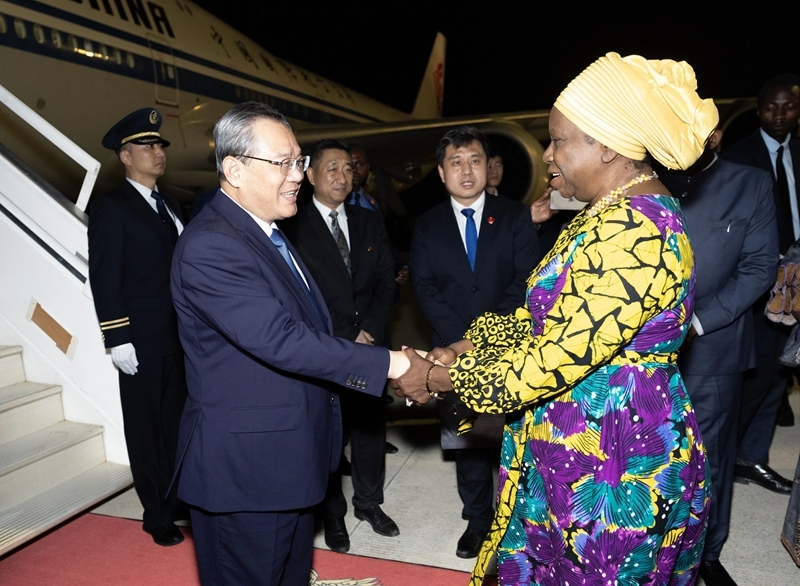
In a visit that blends history, geopolitics and economic ambition, Chinese Premier Li Qiang arrived in Lusaka on Thursday for a two-day state trip widely viewed as a significant reaffirmation of Beijing’s long-standing presence in Zambia. The visit — the first by a Chinese premier in 28 years — comes at a pivotal moment for both countries: Zambia is seeking to stabilise its economy after emerging from a crippling debt crisis, while China is refining its African strategy amid growing global competition for critical minerals and strategic infrastructure.
A railway from another era — renewed for the 21st century
At the centre of Li’s mission is the revival of one of Africa’s most iconic Cold War infrastructure projects: the Tanzania–Zambia Railway, commonly known as Tazara. The 1,860km line, built in the 1970s with Chinese financing and engineering, provided landlocked Zambia with an alternative export route at a time when Southern Africa was dominated by white-minority regimes. For Beijing, the project was a powerful emblem of solidarity with African liberation struggles — and a geopolitical counterweight to Soviet and Western influence.
Today, the railway is being reimagined for a new era of global industrial competition. Zambia and China are expected to sign agreements to kick-start a $1.4 billion modernisation programme, upgrading track systems, locomotives, freight capacity and port linkages to the Tanzanian coastal hub of Dar es Salaam.
Officials say the refurbished line will dramatically smooth the movement of Zambia’s mineral exports, especially copper and cobalt, both essential to modern electronics, electric vehicles and renewable-energy systems.
“This railway is more than steel and sleepers — it is a symbol of resilience and independence,” Zambian President Hakainde Hichilema said at a joint briefing with Premier Li. “The Chinese people took a decision to support their brothers and sisters in Zambia in constructing a trade route to the Indian Ocean, at a time when the southern corridor was blocked by colonial-era politics.”
Copper, cobalt and the race for the minerals of the future
Zambia is Africa’s second-largest copper producer and home to significant cobalt deposits — minerals at the heart of the global clean-energy revolution. China, the world’s dominant processor of critical minerals, is deeply embedded in Zambia’s mining sector through state-owned and private firms.
Beijing’s objective is clear: secure long-term access to strategic metals while strengthening trade routes that bypass geopolitical chokepoints. For Zambia, the railway upgrade could help unlock billions in additional investment, reduce transport costs and support its ambition to expand mining output and domestic processing.
Analysts say the timing is not coincidental.
A surge in global demand for copper — expected to more than double by 2035 — has intensified competition between China, the United States, the European Union and Gulf states for stable supply. While the EU is launching new partnerships across Africa to diversify away from single-source dependence, China is doubling down on infrastructure-led diplomacy, leveraging its decades-long footprint in Zambia.
Debt diplomacy or development partnership?
Li’s arrival comes as Zambia seeks to move beyond one of the most complex sovereign-debt restructurings in modern African history. China, one of Zambia’s largest creditors, played a key role in negotiations that lasted nearly three years. While critics in Western capitals have accused Beijing of slow-walking talks, Zambian officials have been more circumspect, emphasising the need for all lenders — Western and Chinese alike — to take responsibility.
During his remarks, Li sought to shift the narrative away from debt and toward long-term partnership.
China, he said, remains “a good brother, good friend and good partner of Zambia,” and is committed to “steadily enriching our comprehensive strategic cooperative partnership.” He added that Beijing wants to work with Lusaka to “advance the cause of modernisation” and build “a China–Zambia community with a shared future.”
The language, now familiar in Chinese diplomacy, signals Beijing’s desire to present its relationships in Africa as equal and collaborative — a counterpoint to criticisms from some Western governments that Chinese projects create dependency rather than empowerment.
A diplomatic stage-setter ahead of the G20
Li Qiang’s stop in Zambia comes ahead of the Group of 20 summit in South Africa, where global economic governance, supply-chain security and infrastructure investment in developing countries are expected to feature prominently. His presence in Lusaka sends a clear message: China wants to retain its status as Africa’s most influential infrastructure and development partner — even as other powers mount renewed efforts to challenge its dominance.
For Zambia, Li’s visit is a diplomatic balancing act. President Hichilema has positioned himself as an advocate of diversified alliances — strengthening ties with the United States and Europe, courting Gulf investment, and maintaining the strategic relationship with China, which remains central to Zambia’s mining and infrastructure sectors.
What the railway revival means for Zambia — and the region
If completed as planned, the upgraded Tazara line could transform logistics across southern and eastern Africa. With greater cargo capacity and faster transit times, the corridor is expected to provide an alternative to overburdened and costly road transport, boosting Zambia’s competitiveness and integrating its mineral economy more deeply into regional value chains.
The railway could also serve as a model for future China–Africa cooperation: a legacy project modernised to meet contemporary economic needs, blending political symbolism with commercial pragmatism.
A relationship rooted in history — recalibrated for the future
Nearly fifty years after Chinese engineers carved the Tazara line through mountains and valleys at great financial and human cost, the railway is poised for reinvention. Li Qiang’s visit is both a reminder of China’s long historical ties with Zambia and a signal of its enduring ambition to shape Africa’s development trajectory.
As global demand for critical minerals intensifies and geopolitical rivalries deepen, the partnership between China and Zambia — forged in solidarity, tested in crisis, and now recalibrated for modernisation — is entering a new, more strategically charged phase.

Leave a Reply