
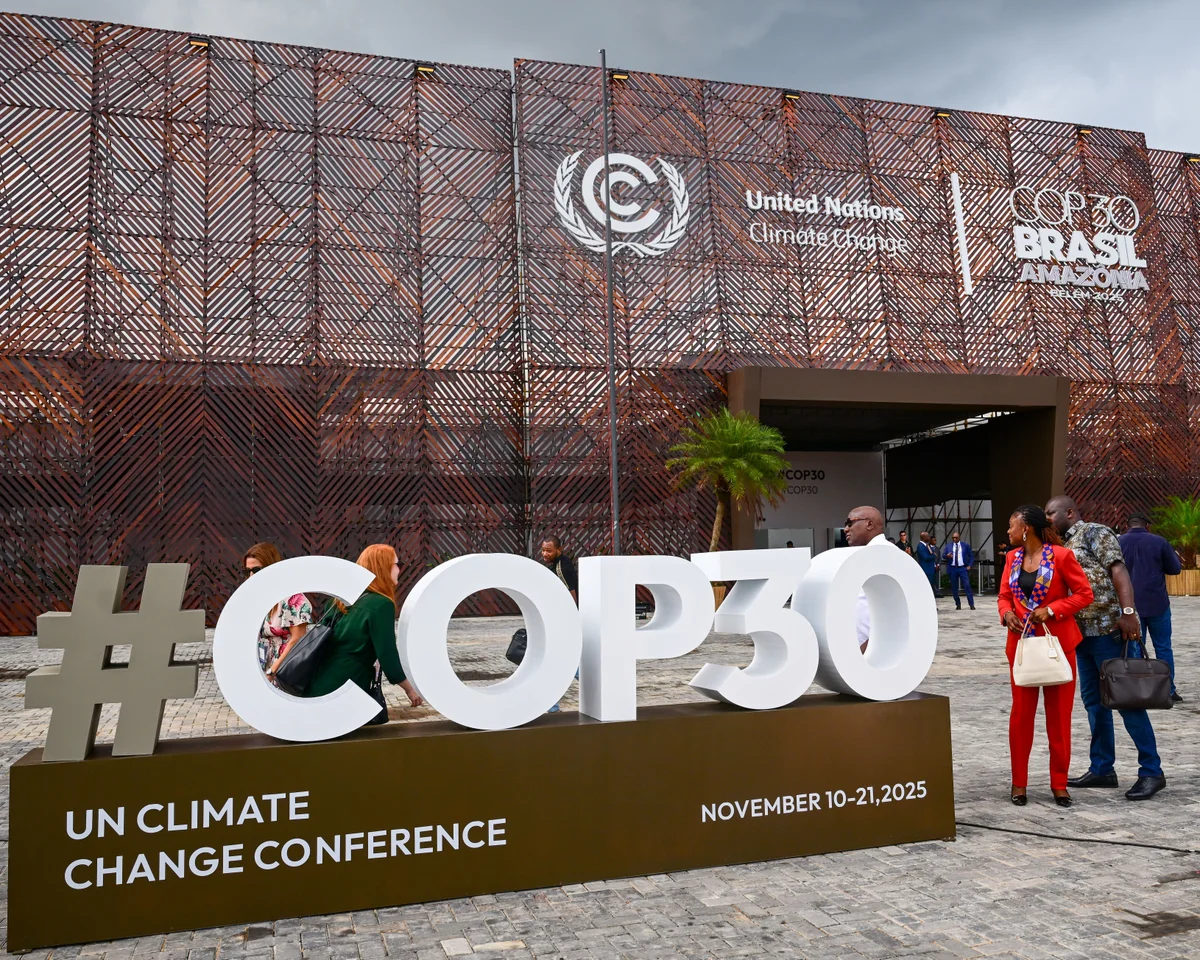
 BELÉM, Brazil — The world’s largest rainforest became the stage for one of humanity’s most consequential conversations as the 30th United Nations Climate Change Conference (COP30) opened Monday in the Brazilian Amazon. The summit began with urgent appeals for solidarity and decisive action, even as the absence of the United States from high-level negotiations cast a shadow over hopes for global consensus.
Gathering at the edge of the Amazon — a region that stands both as a vital carbon sink and a symbol of escalating climate peril — delegates from nearly 200 nations faced renewed warnings that the window to limit global temperature rise to 1.5°C is rapidly closing.
An Indigenous Call to Collective Action
Conference President André Corrêa do Lago, Brazil’s ambassador for climate affairs, inaugurated the summit with a message rooted in Brazil’s Indigenous heritage. Invoking the concept of a “mutirão,” a communal effort where a village comes together to achieve a shared goal, Corrêa do Lago urged delegates to embody cooperation over confrontation.
“This is not just another meeting,” he said. “It is a call for humanity to act together — a mutirão — to protect the planet we all share.”
The symbolism resonated deeply in the host city of Belém, where the dense canopy of the Amazon begins to thin toward the Atlantic, and where local Indigenous leaders have warned that deforestation, mining, and rising temperatures threaten both their ancestral lands and the Earth’s ecological balance.
Outgoing COP29 President Mukhtar Babayev of Azerbaijan echoed the call for unity, cautioning donor nations against retreating from climate commitments amid global instability.
“The changing world is no excuse for backtracking,” Babayev said. “Financial pledges made must be delivered in full. Delay now is defeat later.”
Lula’s Plea: Confront Climate Injustice and Misplaced Priorities
Brazilian President Luiz Inácio Lula da Silva used his keynote address to deliver one of the most impassioned speeches of the opening session — a stark warning about the social and moral costs of climate inaction.
He warned that unchecked global warming could “push millions into hunger and poverty,” reversing decades of progress in reducing inequality. Lula emphasized that Indigenous territories, which cover more than 13% of Brazil’s landmass, are among the world’s most effective barriers against deforestation and carbon loss.
“If the men who make war were here,” Lula declared, “they would see that it is far cheaper to invest $1.3 trillion in solving the climate crisis than to spend $2.7 trillion on war.”
His remarks drew sustained applause and highlighted Brazil’s ambition to position itself as a global broker between the industrialized North and the developing South — a bridge Lula hopes can unify climate diplomacy around equity and shared responsibility.
U.S. Absence Undermines Momentum
But the optimism was tempered by the conspicuous absence of senior American negotiators. The Trump administration’s renewed withdrawal from the Paris Agreement, marking the second time in less than a decade that Washington has stepped away from the accord, has left the world’s second-largest carbon emitter on the sidelines at a pivotal moment.
Diplomats said privately that the absence complicates efforts to secure ambitious collective targets on finance, mitigation, and adaptation — particularly at a summit where credibility and trust are already fragile.
“The U.S. staying out doesn’t just weaken the diplomatic momentum,” said a European delegate. “It risks giving cover to other nations looking for excuses not to act.”
Despite this, European Union representatives, China, and members of the African Union reaffirmed their commitment to the Paris climate goals, emphasizing that multilateralism must endure even in the absence of some major powers.
Amazon at the Center of the Global Climate Equation
The decision to host COP30 in Belém, at the mouth of the Amazon River, was deliberate — both a symbolic and practical reminder of the rainforest’s role in regulating the Earth’s climate. Scientists warn that large swaths of the Amazon are approaching a tipping point, beyond which vast areas could shift from rainforest to savanna, releasing billions of tons of stored carbon.
Brazil has pledged to end illegal deforestation by 2030, part of a broader strategy that includes reforestation, investment in renewable energy, and tighter monitoring of agribusiness expansion. Lula’s government has positioned itself as a leader of the “tropical alliance” — nations rich in biodiversity and natural capital but vulnerable to the economic pressures of climate change.
“Protecting the Amazon is not a favor to the world,” Lula said. “It is an act of survival — for us and for you.”
A Test of Global Cooperation
As negotiations begin, the mood in Belém is a mixture of determination and fatigue. After three decades of annual summits, the pace of global emissions cuts remains far below what scientists deem necessary to avert catastrophic warming. Delegates from developing nations are again pressing for climate finance, loss-and-damage compensation, and fairer access to green technologies.
Observers say COP30 represents a defining test of whether global diplomacy can rise above political rifts and economic competition to confront a shared existential threat.
“From the Amazon to the Arctic, the climate doesn’t wait for election cycles,” said one UN official. “The question is whether the world still believes in working together.”
For now, as the rainforest canopy hums under the tropical sun, the message from the heart of the Amazon is clear: the planet’s lungs are calling for unity — and the world must decide whether to listen.

Leave a Reply