
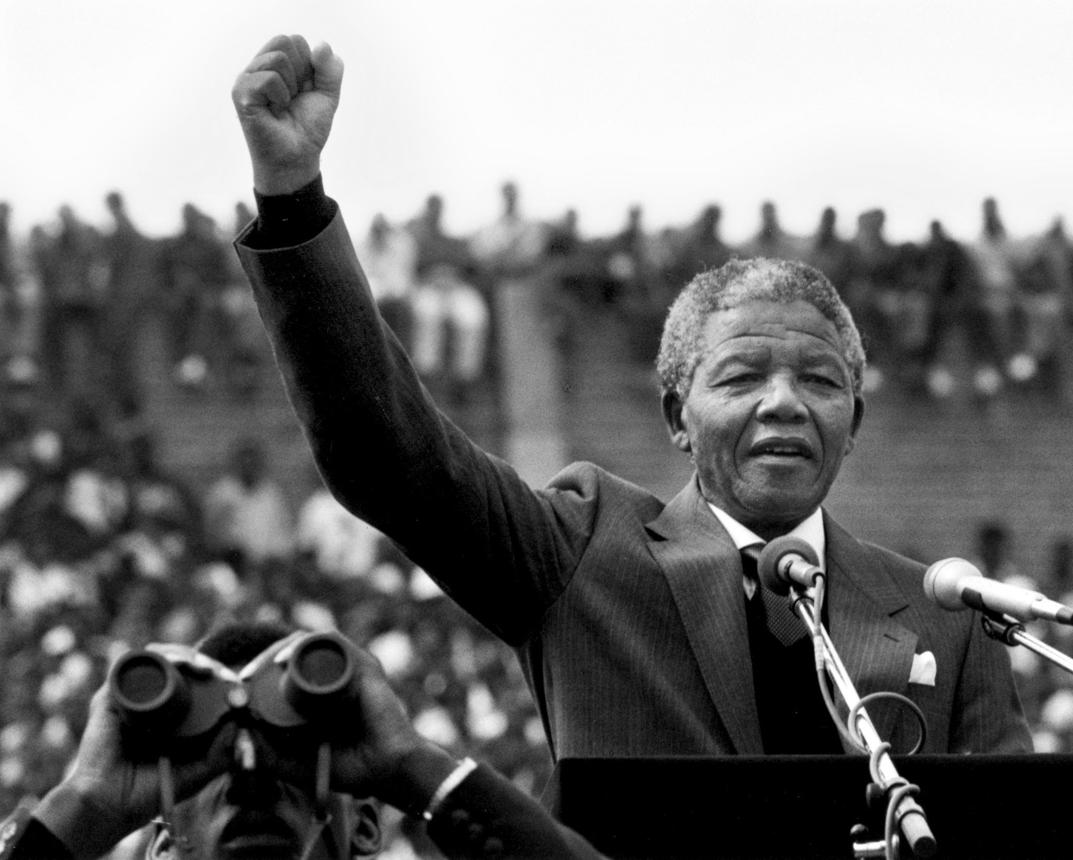
From prisoner to president, from a small village in South Africa to a name recognised across the globe – the extraordinary life of a man whose struggle became part of world history.
AFRICA HALL OF FAME | THE GREATEST AFRICAN PERSONALITIES
There are great men and women who make history. There are extraordinary individuals who change the destiny of their nations. And then there are rare personalities whose names become recognised across the entire world.
Nelson Rolihlahla Mandela belongs to that extraordinary category.
From the villages of South Africa to the world’s most influential political institutions, from the darkness of a prison cell to the highest office in his country, Mandela lived a life that would become one of the most remarkable stories in modern history.
He spent 27 years in prison. He endured the pain of separation from his family. He witnessed the consequences of racial oppression and dedicated much of his life to challenging it. Yet, after his release, he became the leader of a democratic South Africa and an international symbol of freedom, dignity and reconciliation.
His name became known across continents. His image appeared in newspapers, magazines, television broadcasts and history books. World leaders travelled to meet him, international organisations honoured him, and millions of ordinary people came to regard him as an inspiration.
Africa has produced extraordinary emperors, queens, kings, warriors, intellectuals, revolutionaries and pioneers. Its history stretches back thousands of years and contains personalities whose influence shaped entire civilisations.
But when international recognition, worldwide cultural visibility and enduring historical influence are considered together, Nelson Mandela has an exceptional claim to the title:
THE MOST FAMOUS AFRICAN IN HISTORY.
This is the story of the man behind the legend, the sacrifices that shaped his journey and the legacy that made his name known to the world.
1. THE BEGINNING: A BOY BORN IN A SMALL AFRICAN VILLAGE
On 18 July 1918, in Mvezo, a rural village in South Africa’s Eastern Cape, a boy was born into the Madiba clan of the Thembu people.
His name was Rolihlahla Mandela.
His father, Gadla Henry Mphakanyiswa, was a counsellor to the Thembu royal family. His mother was Nonqaphi Nosekeni.
Mandela was born into a traditional African society with a rich cultural heritage and a strong history of community leadership.
Following his father’s death, the young Mandela became a ward of the Thembu regent, Jongintaba Dalindyebo, and grew up at the Great Place in Mqhekezweni.
There, he listened to elders discuss leadership, justice, history and the struggles of African communities.
Those early experiences helped shape his understanding of responsibility and the importance of serving a community.
At school, one of his teachers gave him the English name Nelson, following the naming customs of the time.
He later attended the University College of Fort Hare, an important institution for Black African education, before moving to Johannesburg.
It was in Johannesburg that his political consciousness developed further.
He encountered the realities of racial discrimination, witnessed the limitations imposed on Black South Africans and became increasingly involved in the movement for political and civil rights.
The boy from Mvezo was beginning a journey that would eventually take him far beyond the borders of his homeland.
2. THE FIGHT AGAINST APARTHEID: THE MAN WHO REFUSED TO ACCEPT INJUSTICE
To understand Mandela’s place in history, one must understand apartheid.
Apartheid was a system of institutionalised racial segregation and discrimination enforced by South Africa’s white minority government.
It controlled where people could live, work, study and travel. It denied the Black majority equal political rights and maintained a society divided by race.
For millions of Black South Africans, apartheid meant restricted opportunities, forced removals, discrimination, political exclusion and the daily humiliation of being treated as inferior in their own country.
Mandela could not accept such a system.
In 1944, he joined the African National Congress (ANC) and helped establish its Youth League alongside Walter Sisulu, Oliver Tambo and other young activists.
He believed that the struggle for equality required organisation, determination and the participation of ordinary people.
In 1952, he became one of the leading figures in the Defiance Campaign, a programme of civil disobedience against discriminatory laws.
In the same year, he and Oliver Tambo established Mandela & Tambo, a legal practice that provided legal assistance to Black South Africans who frequently faced discrimination.
As the apartheid government intensified its repression, Mandela became one of the country’s most prominent resistance leaders.
Following the banning of the ANC in 1960, the struggle entered a new and more dangerous phase.
In 1961, Mandela helped establish Umkhonto we Sizwe, the armed wing associated with the ANC, which initially pursued sabotage against government infrastructure.
His political journey involved difficult and controversial decisions, which must be understood in the historical context of apartheid and the repression of resistance movements.
What remained constant was his opposition to a political system that denied the majority of South Africans fundamental rights.
3. THE RIVONIA TRIAL: THE WORDS THAT ECHOED AROUND THE WORLD
Mandela’s determination eventually came at an enormous personal cost.
He was arrested in August 1962 and sentenced to five years in prison for leaving the country without permission and inciting workers to strike.
In 1963, following a police raid on Liliesleaf Farm in Rivonia, several leading anti-apartheid activists were arrested.
Mandela, already imprisoned, was brought into the subsequent Rivonia Trial.
The trial became one of the most significant events in South African political history.
Mandela and his co-accused faced the possibility of the death penalty.
On 20 April 1964, Mandela delivered his famous statement from the dock, explaining his commitment to a democratic society in which people of all races could live together with equal opportunities.
His final words became immortalised in history:
“I am prepared to die.”
They were words that reflected the seriousness of his convictions and his willingness to sacrifice his life for the principles he believed in.
On 12 June 1964, Mandela and seven other defendants were sentenced to life imprisonment.
He was sent to Robben Island.
His struggle had entered a new chapter, one in which the world would increasingly come to know him as a symbol of resistance.
4. 27 YEARS IN PRISON: THE SACRIFICE BEHIND THE LEGEND
Nelson Mandela spent more than 27 years in prison.
Eighteen of those years were spent on Robben Island, where prisoners endured harsh conditions, demanding labour and severe restrictions on communication with their families.
He was known by his prison number, 466/64.
His imprisonment was not simply a loss of personal freedom. It meant missing important years of his children’s lives, being separated from his family and losing the opportunity to participate in ordinary moments that most people take for granted.
His mother died in 1968. His eldest son, Thembi, died in 1969.
Mandela was not permitted to attend either funeral.
Outside prison, his name was becoming increasingly powerful.
International campaigns called for his release. Universities, churches, trade unions, political organisations and anti-apartheid activists around the world demanded an end to apartheid.
The campaign to free Mandela became part of a much wider international movement against racial discrimination in South Africa.
He became one of the most famous political prisoners in the world.
His imprisonment helped focus international attention on apartheid and on the sacrifices of South Africans fighting for freedom.
Yet Mandela was never the only person responsible for the struggle. Thousands of activists and ordinary citizens contributed to the movement, many of whom suffered imprisonment, violence and death.
His growing international prominence helped bring their struggle to a global audience.
The prison walls had taken away his freedom, but they could not erase his influence.
5. 11 FEBRUARY 1990: THE DAY THE WORLD WITNESSED HISTORY
After years of international pressure and political negotiations, Nelson Mandela was released from prison on 11 February 1990.
He walked out of Victor Verster Prison after 27 years behind bars.
The moment was broadcast internationally.
Images of Mandela walking to freedom, his fist raised alongside his then-wife Winnie Madikizela-Mandela, became some of the most memorable photographs of the twentieth century.
It was a defining moment in the struggle against apartheid.
Mandela emerged from prison to a country still experiencing serious political tensions, violence and uncertainty.
He immediately became involved in negotiations aimed at ending white minority rule and establishing a democratic political system.
The process was difficult. There were disagreements, violence and moments when the future of South Africa appeared uncertain.
But the negotiations continued.
In 1993, Mandela and South African President F.W. de Klerk jointly received the Nobel Peace Prize for their efforts to bring about a peaceful end to apartheid and establish the foundations of a democratic South Africa.
The man who had spent decades in prison was now receiving one of the world’s most prestigious international awards.
His story had become an international symbol of political transformation.
6. 1994: THE PRISONER BECOMES PRESIDENT
On 27 April 1994, South Africa held its first democratic elections based on universal adult suffrage.
For the first time, citizens of all races could participate equally in choosing the country’s national government.
Millions of South Africans voted.
For many, it was the fulfilment of a struggle that had lasted generations.
On 10 May 1994, Nelson Mandela was inaugurated as South Africa’s first democratically elected Black president.
It was an extraordinary historical moment.
The man who had been imprisoned by the apartheid government was now leading the country towards a new democratic future.
Mandela’s presidency was about more than holding political office.
He faced the enormous responsibility of helping rebuild a deeply divided society.
His administration worked to strengthen democratic institutions, advance national reconciliation and establish a new constitutional order.
The Truth and Reconciliation Commission became an important part of the country’s effort to confront human rights violations committed during apartheid.
Mandela also promoted a message of national unity, encouraging South Africans to build a common future rather than remain trapped in the divisions of the past.
In 1999, after completing one presidential term, he stepped down.
He did not seek to remain in office indefinitely.
His departure reinforced the importance of constitutional democracy and the peaceful transfer of political power.
7. WHY THE WHOLE WORLD KNOWS NELSON MANDELA
What makes Mandela different from many other great African historical figures is the extraordinary reach of his international recognition.
His name became familiar in countries across Africa, Europe, Asia, North America, South America and beyond.
He was not simply known among political leaders or historians. His story reached ordinary people through television, newspapers, books, documentaries, music, educational institutions and international campaigns.
There are several reasons for this extraordinary recognition.
A. His struggle became a global cause
The anti-apartheid movement attracted worldwide attention. Mandela became its most internationally recognisable imprisoned figure.
B. His story was extraordinary
The journey from imprisonment to the presidency captured the imagination of people across different cultures and generations.
C. His influence crossed political boundaries
Although he was a political leader with a particular ideological and historical background, his story resonated with people who supported freedom, equality and human dignity.
D. International institutions recognised his contribution
He received the Nobel Peace Prize, numerous international honours and recognition from governments and institutions around the world.
E. His legacy continues to be celebrated
The United Nations established Nelson Mandela International Day, observed annually on 18 July. His name is also attached to the United Nations Standard Minimum Rules for the Treatment of Prisoners, commonly known as the Nelson Mandela Rules.
His influence continues to be recognised in education, human rights, public service and international discussions about justice.
Very few Africans have achieved this level of worldwide visibility.
8. THE MAN BEYOND POLITICS: HUMANITARIANISM AND SERVICE
Mandela did not consider his responsibility to society finished when he left the presidency.
In 1995, he established the Nelson Mandela Children’s Fund to improve the lives of children and young people.
He supported initiatives addressing education, poverty, health and social development.
In 2003, the 46664 campaign was launched to raise awareness about HIV/AIDS, using his former prison number as its name.
He also supported the Mandela Rhodes Foundation, which promotes leadership development in Africa.
His work reflected a belief that the future of the continent depended on investing in people, particularly younger generations.
His international reputation allowed him to use his influence to draw attention to issues affecting vulnerable communities.
He became more than a former president. He became a global advocate for humanitarian causes.
9. THE FINAL CHAPTER: A WORLD MOURNS AN AFRICAN LEGEND
Nelson Mandela gradually withdrew from public life in his later years.
On 5 December 2013, he died at his home in Johannesburg at the age of 95.
The reaction was extraordinary.
World leaders, presidents, monarchs, international organisations, celebrities and ordinary people expressed their condolences.
Tributes came from across the world.
South Africa mourned a former president and a central figure in its democratic history.
Africa mourned one of its most celebrated sons.
The international community remembered a man whose life had become a powerful symbol of the struggle against oppression.
His funeral and memorial events attracted worldwide attention.
The scale of the response demonstrated the remarkable international recognition he had achieved during his lifetime.
His name was no longer simply associated with South African politics. It had become part of the shared vocabulary of modern world history.
10. AFRICA’S GREATEST HISTORICAL PERSONALITIES: WHERE DOES MANDELA STAND?
Africa’s history is far too rich to be represented by one individual.
The continent has produced rulers, scholars, military leaders, revolutionaries, scientists, writers, entrepreneurs and humanitarians whose contributions deserve international recognition.
Consider some of the extraordinary personalities who shaped African and world history:
Mansa Musa – Mali
The fourteenth-century emperor of Mali is remembered for the wealth and influence of his empire and his famous pilgrimage to Mecca.
Cleopatra VII – Ancient Egypt
The last active ruler of the Ptolemaic Kingdom of Egypt, Cleopatra remains one of the most recognisable women of the ancient world.
Queen Nzinga – Angola
A powerful seventeenth-century ruler remembered for her political leadership and resistance to Portuguese expansion.
Shaka Zulu – Southern Africa
The Zulu king whose military and political leadership profoundly influenced the history of southern Africa.
Kwame Nkrumah – Ghana
A leading figure in Ghana’s independence movement and a prominent advocate of African unity.
Haile Selassie – Ethiopia
Emperor of Ethiopia and an important figure in twentieth-century African diplomacy and the history of Pan-Africanism.
Wangari Maathai – Kenya
The environmentalist and Nobel Peace Prize laureate whose Green Belt Movement transformed environmental activism and women’s participation in community development.
Each of these personalities occupies an important place in African history.
However, Mandela’s international visibility, modern media presence, symbolic importance and enduring global recognition make him a particularly strong candidate for the distinction of the most famous African in history.
This is an editorial judgement, not a universally established historical ranking. Fame can be interpreted in different ways, and ancient figures must be considered within the limitations of historical records and changing forms of communication.
Nevertheless, Mandela’s worldwide recognition is difficult to overlook.
11. THE MANDELA LEGACY: WHAT AFRICA AND THE WORLD CAN LEARN
Mandela’s life offers important lessons that extend beyond politics.
The power of perseverance: His 27 years in prison demonstrated the enormous personal sacrifices involved in his political struggle.
The importance of education: His commitment to learning and his legal training helped shape his understanding of justice and public responsibility.
The value of reconciliation: His approach to South Africa’s transition showed the importance he placed on building a shared democratic future.
The responsibility of leadership: His decision to leave office after one term demonstrated the importance of constitutional institutions and democratic succession.
The importance of service: His humanitarian activities reflected a belief that public influence should be used to improve the lives of others.
However, Mandela’s legacy should not be romanticised as a complete solution to South Africa’s challenges.
Apartheid ended as a system of government, but its economic and social consequences did not disappear. Poverty, inequality and social divisions remained significant challenges.
His contribution was historic, but the work of building a fair and equal society continues.
That is why his story must be remembered alongside the contributions of the many people who fought for freedom and those who continue working towards justice.
AFRICA HALL OF FAME: THE VERDICT
WHY NELSON MANDELA IS OUR CHOICE FOR THE MOST FAMOUS AFRICAN IN HISTORY
What makes a person the most famous African in history?
Is it wealth? Political power? Military achievement? Cultural influence? International recognition? Or the ability to leave a legacy that survives generations?
There is no single measurement that can settle this question.
But when we consider the extraordinary reach of Nelson Mandela’s name, the historical importance of his life and the international recognition he received, his claim is exceptionally strong.
He was born in a rural African village, became a lawyer, fought against apartheid, spent 27 years in prison, helped lead his country into democracy and became one of the most recognisable political figures of the twentieth century.
His story reached people far beyond South Africa.
He became a symbol of resistance for those fighting oppression, an international statesman for those promoting peace and a source of inspiration for generations who believe that individuals can make a difference.
For Africa Hall of Fame, Mandela represents the remarkable capacity of an African individual to influence the course of world history.
He deserves to be celebrated not because he was without flaws, but because of the extraordinary historical significance of his achievements.
Our position is clear: Nelson Rolihlahla Mandela is our choice for the most famous African in history.
THE FINAL WORD: A NAME THAT WILL NEVER DIE
Nelson Mandela’s journey began in a small village in South Africa.
It took him through the corridors of political struggle, the isolation of prison, the challenges of national leadership and the international stage.
He experienced hardship that would have broken many people. He sacrificed decades of his life for a political cause. He emerged from prison to lead a nation through one of the most important transitions in modern African history.
And when he died, the world remembered him.
Today, his name continues to appear in schools, universities, libraries, museums, documentaries, historical discussions and international institutions.
His story is taught to young people who were not yet born when he walked out of prison in 1990.
His legacy remains part of the history of freedom, democracy and human dignity.
Africa has given the world countless extraordinary personalities. Mandela stands among the most celebrated.
He showed the world that an African born in a small village could become a figure of international historical importance.
He demonstrated that imprisonment could not erase a person’s influence and that a nation’s future could be transformed through courage, political struggle and negotiation.
He entered prison as a freedom fighter. He walked out as a global icon. He became president. And he left behind a legacy that belongs to the world.
NELSON ROLIHLAHLA MANDELA – THE MOST FAMOUS AFRICAN IN HISTORY.
AFRICA HALL OF FAME
Celebrating Africa’s greatest personalities. Preserving our history. Honouring our legends. Inspiring future generations.
HISTORICAL PROFILE
- Full name: Nelson Rolihlahla Mandela
- Born: 18 July 1918
- Birthplace: Mvezo, Eastern Cape, South Africa
- Died: 5 December 2013
- Age: 95
- Nationality: South African
- Profession: Lawyer, anti-apartheid activist, political leader and statesman
- Political organisation: African National Congress
- Prison sentence: Life imprisonment in 1964
- Time imprisoned: More than 27 years
- Released: 11 February 1990
- Nobel Peace Prize: 1993, jointly with F.W. de Klerk
- Presidency: 1994–1999
- Historical distinction: South Africa’s first democratically elected Black president
- International recognition: One of the world’s most recognised African historical figures
