Africa Hall of Fame: Power 100
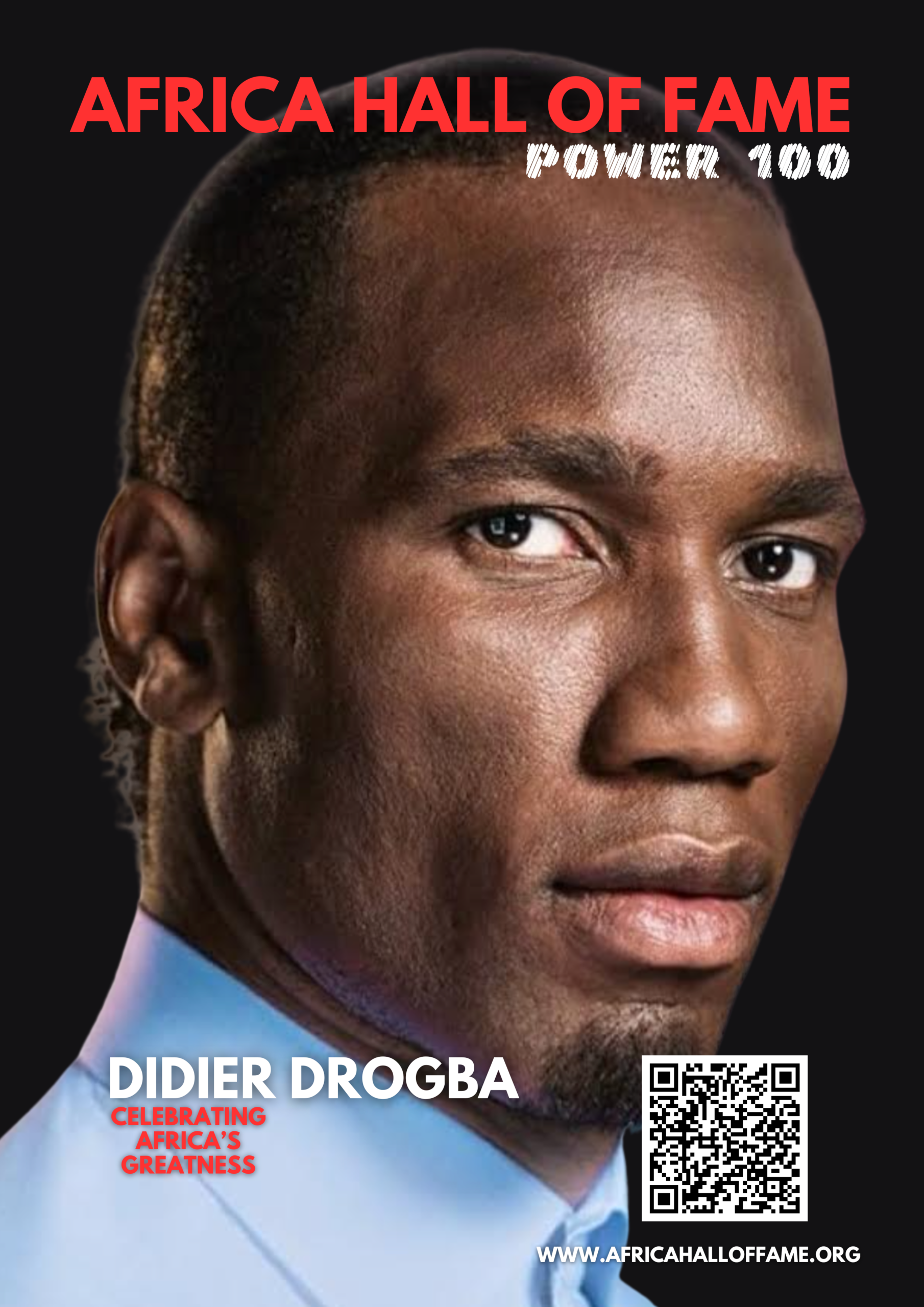
Didier Drogba: The Power of Influence Beyond Football
A Different Kind of Power
Didier Drogba represents a rare form of power that extends beyond sport into politics, peacebuilding, and continental identity. While his foundation was built on elite football performance, his lasting influence is defined by his role as a unifying national figure and a symbolic bridge between sport and society.
In modern global sport, a few athletes transcend competition to become cultural and political symbols. Drogba belongs to this category—where influence is measured not only in goals scored, but in social impact, national unity, and legacy beyond the pitch.
His power is both visible and intangible: forged in stadiums, but expressed in national history.
From Abidjan to the Global Stage
Drogba’s journey reflects the archetype of modern African sporting ascent. Born in Côte d’Ivoire, he moved through developmental systems in France before rising into elite European football.
His defining breakthrough came at Chelsea F.C., where he became one of the most decisive forwards in the club’s modern era. Known for strength, aerial dominance, and composure in high-pressure moments, he evolved into a player built for decisive matches.
At the highest level, Drogba was not simply a striker—he was a finals performer. His reputation was built on delivering in the most consequential moments of club football.
Defining Moments on the Pitch
Drogba’s career is marked by pivotal performances that shaped club history. His ability to influence cup finals and decisive league matches positioned him as one of the most reliable forwards of his generation.
He combined physical presence with technical precision, excelling in hold-up play, penalty execution, and leadership in attacking transitions.
At his peak, he was a player who altered outcomes at the highest competitive level—where margins define legacy.
The 2012 Final and Sporting Immortality
One of the defining chapters of Drogba’s career came in the UEFA Champions League final, where he scored the equalising goal and the decisive penalty that secured Chelsea’s first European title.
That moment elevated him beyond club legend status into global football history. It symbolised composure under extreme pressure and cemented his identity as a player built for defining stages.
In elite sport, few moments carry such concentrated historical weight. For Drogba, it became a legacy-defining event.
Footballer as Political Symbol
Drogba’s influence extends beyond sport into national history. During periods of political instability in Côte d’Ivoire, he played an unexpected but significant symbolic role in calls for peace and unity.
His public appeal for reconciliation resonated nationally, demonstrating how sporting figures can occupy moral and unifying spaces within fractured societies.
In this context, his power was not athletic—it was societal.
Global Ambassador of African Excellence
Drogba became one of the most globally recognised African footballers of his generation. His success helped redefine perceptions of African strikers in European football systems, where he was viewed as both a physical force and a tactical asset.
He contributed to shifting the narrative around African talent in global sport—from peripheral contribution to central influence.
His legacy also opened pathways for broader African representation in elite football environments.
Leadership Beyond Retirement
After his playing career, Drogba transitioned into roles that extend his influence beyond football. He has been involved in humanitarian initiatives, football development, and institutional engagement within sport governance.
His post-playing identity reflects a continuation of leadership—moving from performance-based influence to structural and symbolic roles.
This transition is a key feature of modern sporting power: legacy extended through institution-building and advocacy.
The Economics of Legacy
In contemporary football, legacy is not only emotional—it is commercial and institutional. Drogba’s name remains embedded in global football memory, brand value, and club identity.
His association with Chelsea’s golden era continues to carry cultural and commercial weight, reinforcing the long-term value of elite sporting achievement.
Legacy in football operates as enduring capital—both symbolic and economic.
A Model of Multifaceted Power
Drogba represents a model of power built across three dimensions:
- Athletic excellence at elite European level
- Symbolic national influence during political tension
- Global cultural recognition as an African sporting icon
Few athletes operate simultaneously across these domains.
Defining Power Through Impact and Identity
The Africa Hall of Fame: Power 100 recognises individuals whose influence extends beyond their primary field into broader systems of meaning and impact.
Didier Drogba embodies this principle through football excellence and societal influence. He is a player whose legacy is not confined to goals or trophies, but expanded through leadership, symbolism, and cultural significance.
His power lies in convergence—where sport meets identity, and performance meets history.
For this reason, his place in the Africa Hall of Fame: Power 100 reflects a form of power rooted not only in athletic greatness, but in enduring continental influence and global recognition.