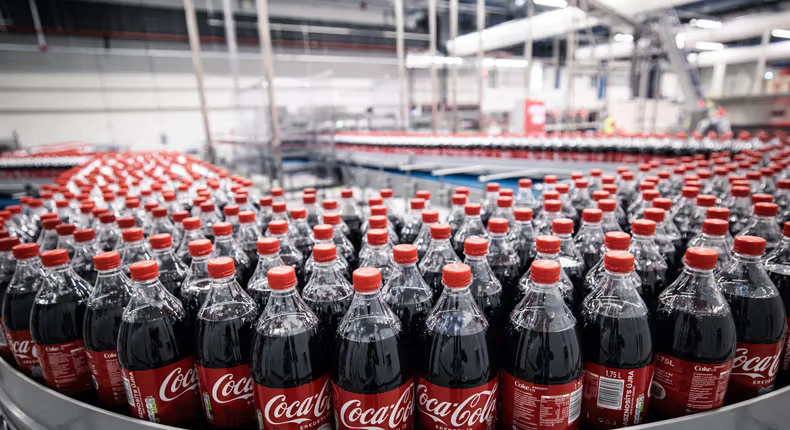
The Coca-Cola Company is bracing for a $1 billion impairment charge in the fourth quarter of 2025, as the beverage giant prepares to divest part of its ownership in its African bottling business — a move signaling both a financial reshuffle and a strategic pivot toward a more asset-light model in emerging markets.
The charge, disclosed in a regulatory filing on Thursday, follows Coca-Cola Hellenic Bottling Company (Coca-Cola HBC)’s agreement to acquire a 75% stake in Coca-Cola Beverages Africa (CCBA) for $2.6 billion, valuing the business at approximately $3.4 billion, according to people familiar with the deal.
A Strategic Shake-Up in Coca-Cola’s Bottling Empire
The transaction will see Swiss-based Coca-Cola HBC, one of the world’s largest Coca-Cola bottlers, purchase Coca-Cola Co.’s 42% share in CCBA along with the entire Gutsche Family Investments stake.
Once completed, the deal will transform Coca-Cola HBC into the second-largest Coca-Cola bottler globally by sales volume, trailing only Coca-Cola FEMSA of Mexico.
Coca-Cola Beverages Africa, which operates across 14 African markets including South Africa, Nigeria, Kenya, Ethiopia, and Ghana, employs over 17,000 people and manufactures leading beverage brands such as Coca-Cola, Fanta, Sprite, and Bonaqua.
Pull Stat: $1 billion — the impairment charge Coca-Cola expects in Q4 2025 linked to its African divestment.
The sale is expected to close by late 2026, subject to regulatory approvals in multiple jurisdictions. Coca-Cola Co. will retain a 25% minority stake in CCBA, with Coca-Cola HBC holding an option to acquire the remaining shares within six years of closing.
Why Coca-Cola Is Selling
Analysts say the move underscores Coca-Cola’s ongoing strategy to focus on brand ownership and marketing rather than direct bottling operations — a shift the company began nearly a decade ago.
By reducing its exposure to capital-intensive manufacturing and distribution, the Atlanta-based firm aims to improve margins and allocate resources toward product innovation and digital marketing.
“Coca-Cola is increasingly becoming a brand and consumer company rather than a bottling operator,” said John O’Brien, a consumer goods analyst at Bernstein Research. “This sale reflects that strategy, even if it means taking a short-term accounting hit.”
The $1 billion impairment charge, O’Brien added, is largely a non-cash adjustment to reflect the lower book value of Coca-Cola’s investment in CCBA relative to the agreed sale price.
Coca-Cola HBC’s African Ambition
For Coca-Cola HBC, which is headquartered in Switzerland and listed on both the London Stock Exchange and the Athens Exchange, the acquisition marks a bold bet on Africa’s long-term growth story.
The bottler said the deal would “significantly strengthen its position in high-growth emerging markets,” particularly as Africa’s population is projected to exceed 1.7 billion by 2030.
Pull Stat: Coca-Cola HBC’s $2.6 billion acquisition will make it the world’s No. 2 Coca-Cola bottler by volume.
“The African continent represents one of the most exciting growth opportunities globally,” said Zoran Bogdanovic, CEO of Coca-Cola HBC. “This acquisition positions us to capture the consumption potential of Africa’s fast-growing, youthful population.”
To underscore its long-term commitment to the continent, Coca-Cola HBC also announced plans to pursue a secondary stock listing on the Johannesburg Stock Exchange (JSE) — a symbolic and strategic move that brings it closer to its largest regional market base.
Africa’s Growth: The Beverage Industry’s Next Frontier
Africa’s beverage consumption per capita remains well below the global average, but it is expanding rapidly as incomes rise and urbanization accelerates.
Industry analysts project that non-alcoholic beverage volumes in Africa could grow by 5–6% annually over the next decade, outpacing all other global regions.
Coca-Cola HBC hopes to leverage CCBA’s vast production network and established distribution channels to tap into this growth, with plans to invest in refrigeration, local sourcing, and digital retail platforms to improve efficiency and sustainability.
Pull Stat: Africa’s beverage market is forecast to grow at over 5% annually through 2035.
However, challenges persist. The continent faces currency volatility, infrastructure gaps, and inflationary pressures, which can squeeze margins for bottlers dependent on imported materials.
Additionally, water scarcity and energy costs remain long-term risks for beverage producers operating in sub-Saharan Africa.
Coca-Cola Co. Maintains Global Momentum
The African divestment comes as Coca-Cola Co. reported robust third-quarter 2025 earnings, driven by strong sales of Coca-Cola Zero Sugar, Fairlife dairy products, and Fuze Tea.
International markets, particularly in Latin America and Asia, also performed above expectations, offsetting currency headwinds and cost inflation.
In a statement, Coca-Cola said the impairment related to the CCBA sale would not affect its cash flow or dividend policy, describing the charge as “accounting-driven rather than operational.”
“We remain deeply committed to the African continent through our brands, partnerships, and community investments,” the company said. “This transaction allows us to simplify our structure and enable local growth under a trusted partner.”
A Win-Win — With a Price Tag
Market observers view the deal as mutually beneficial, though the financial impact differs for each party.
For Coca-Cola Co., the sale reduces exposure to volatile African currencies and operational complexity — at the cost of a one-time $1 billion impairment.
For Coca-Cola HBC, it represents an ambitious leap into the world’s youngest and fastest-growing beverage market, albeit with greater regional risk.
Pull Stat: Coca-Cola retains a 25% stake in CCBA and an option to sell the remainder within six years.
“Coca-Cola HBC is positioning itself as Coca-Cola’s growth engine in Africa,” said Sipho Ndlovu, a Johannesburg-based beverage industry analyst. “But this expansion will require patience and resilience — Africa offers big rewards, but only to companies willing to navigate its complexities.”
Looking Ahead
Once finalized, the deal is expected to reshape Coca-Cola’s global bottling landscape, consolidating operations under fewer, more regionally focused partners.
If growth projections hold, Africa could account for nearly 10% of Coca-Cola’s global beverage volumes by 2030 — a testament to the continent’s rising economic influence.
For now, investors will be watching how the impairment charge affects Coca-Cola’s year-end financials and whether Coca-Cola HBC’s African gamble will pay off in the decade ahead.
Pull Stat: The CCBA transaction is expected to close by late 2026, pending regulatory approvals across 14 markets.
Leave a Reply