
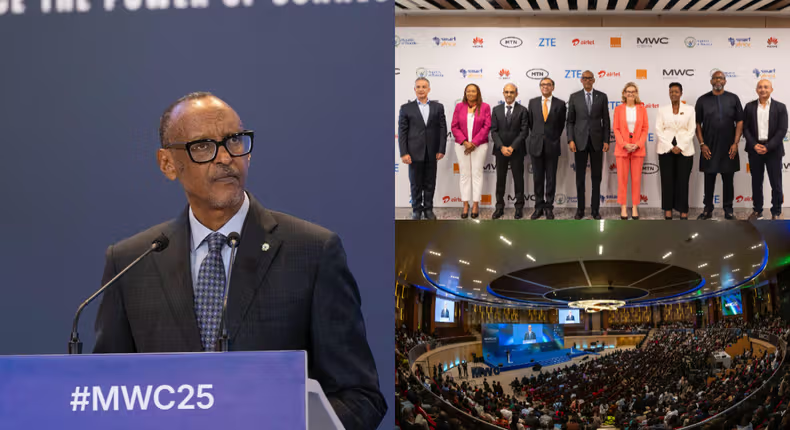

Kigali, Rwanda — Africa’s fast-growing mobile technology industry has become one of the continent’s biggest economic engines, contributing an estimated $220 billion — or 7.7% of GDP — in 2024, according to a new report by the GSMA, the global body representing mobile operators.
The findings, unveiled at the Mobile World Congress Africa 2025 in Kigali, show how connectivity is transforming African economies, from digital payments to education, while warning that deep gaps in affordability and access still threaten to leave millions behind.
A Digital Powerhouse in Motion
The GSMA report paints a bold picture of a continent in digital motion.
By 2030, mobile technology’s contribution to Africa’s GDP could rise to $270 billion, driven by artificial intelligence (AI), fintech expansion, and the rapid rollout of 4G and 5G networks.
Pull Stat: Mobile technology contributed $220 billion to Africa’s GDP in 2024 — a 7.7% share of total output.
“Mobile technology is not just connecting people, it’s creating economies,” said Angela Wamola, Head of Sub-Saharan Africa at GSMA.
She added that the next wave of digital transformation will hinge on how effectively the continent integrates AI, mobile innovation, and financial technology into everyday life.
“The question for Africa is no longer whether digital transformation will happen — it’s how inclusive it will be,” Wamola said.
Connectivity as the Backbone of Africa’s Modern Economy
Mobile connectivity has emerged as the backbone of Africa’s 21st-century economy, transforming how people work, trade, and access essential services.
From smallholder farmers using mobile weather alerts to fintech startups driving cashless payments, the mobile ecosystem has unlocked unprecedented opportunities across sectors such as agriculture, logistics, healthcare, and education.
The GSMA estimates that nearly half a billion Africans now use mobile internet, and the number continues to grow each year as smartphones become cheaper and mobile coverage expands.
Pull Stat: Over 90% of Africans now live within reach of 3G or 4G coverage — but only 58% actively use mobile internet.
However, this success story is not without setbacks. Despite widespread network access, millions remain offline due to cost barriers, limited digital literacy, and lack of trust in online systems.
Experts warn that bridging this “usage gap” is now the biggest challenge to achieving full digital inclusion.
The AI and 5G Frontier: Powering the Next Leap
The GSMA projects that AI-driven technologies and next-generation mobile networks will be pivotal in driving Africa’s economic future.
By 2035, the integration of AI, machine learning, and automation could double Africa’s GDP growth rate, revolutionizing industries from education to energy management.
Already, countries like Kenya, South Africa, and Egypt are experimenting with AI in agriculture, traffic control, and health diagnostics. Meanwhile, telecom operators across Nigeria, Ghana, and Tanzania are rolling out 5G networks designed to support smart cities, industrial automation, and digital finance ecosystems.
But analysts caution that this transition will require significant investment in infrastructure, regulatory harmonization, and human capital development to ensure that Africa’s digital expansion remains equitable and sustainable.
Rwanda: A Model for Digital Inclusion
Rwanda has emerged as a regional role model for digital transformation, demonstrating how political will and public-private collaboration can close the connectivity gap.
According to Rwanda’s Minister of ICT and Innovation, Paula Ingabire, the country has increased its number of 4G users from just 500,000 in 2023 to 5 million by 2025 — a tenfold surge achieved through national strategies and partnerships with private telecom firms.
“By ensuring the promise of connectivity reaches every home, school, and hospital, we are transforming lives,” Ingabire said during the summit.
Under the Digital Ambassadors Program, Rwanda has connected nearly 1,000 health facilities, 4,000 schools, and trained 4.5 million citizens in basic digital literacy. The initiative aims to ensure that no one is excluded from the country’s digital revolution.
“We must connect people, ideas, and markets — and create solutions designed in Africa, built for Africa, and scaled to the world,” Ingabire emphasized.
Trust, Security, and the Human Side of Tech
While the infrastructure boom has been impressive, experts warn that trust and data security remain critical barriers to digital adoption.
Jeanes Viljoen, a technology analyst at PwC Africa, said the sustainability of Africa’s digital growth depends not only on innovation but also on consumer protection and data governance.
“People need to feel confident that their data, savings, and transactions are secure,” Viljoen noted. “Without trust, connectivity alone cannot drive inclusion.”
As digital platforms handle increasing volumes of financial transactions and personal information, regulatory agencies are under pressure to enforce stronger cybersecurity frameworks, data privacy laws, and ethical AI standards.
Several African countries — including Kenya, Ghana, and South Africa — have recently updated their data protection legislation, but implementation remains uneven.
Pull Stat: Only 58% of mobile users in Africa go online regularly, with affordability and data privacy concerns cited as top barriers.
The Promise and the Paradox
Africa’s digital economy has become a paradox of progress: soaring mobile connectivity coexisting with stark inequalities.
While urban areas and tech hubs flourish, rural regions still struggle with network quality, low incomes, and limited digital literacy.
The GSMA estimates that over 800 million Africans remain unconnected, largely due to affordability challenges — with mobile internet costs still exceeding 2% of monthly income for many low-income households.
This divide threatens to slow Africa’s digital transformation just as the continent begins to unlock its potential as a global innovation hub.
Bridging the divide, analysts say, will require coordinated action from governments, regulators, and the private sector.
Toward a $270 Billion Digital Future
If current trends continue, Africa’s mobile technology ecosystem could contribute $270 billion to the continent’s GDP by 2030, a 23% increase from 2024 levels.
That growth will be powered by expanding broadband access, AI adoption, fintech innovation, and the integration of mobile solutions into key industries like agriculture, health, and public administration.
Pull Stat: Africa’s mobile economy could reach $270 billion by 2030, up from $220 billion in 2024.
But GSMA officials warn that inclusive growth will depend on reducing data costs, improving network reliability, and ensuring that Africa’s 1.4 billion citizens can participate in — and benefit from — the digital revolution.
“Africa’s digital transformation is unstoppable,” said Wamola. “But its success will depend on whether every citizen — not just the connected elite — can share in the value it creates.”
Conclusion: A Digital Decade in the Making
As Africa enters what many are calling its “digital decade,” the story of its mobile economy is both inspiring and instructive.
The continent has proven that with innovation and ambition, technology can be a catalyst for broad-based growth and inclusion. Yet the task ahead — closing the digital divide — will determine whether this momentum translates into long-term prosperity.
From Kigali to Lagos, from Nairobi to Accra, the message is clear: Africa’s digital future is bright — but only if connectivity comes with confidence, and innovation comes with inclusion.

Leave a Reply