
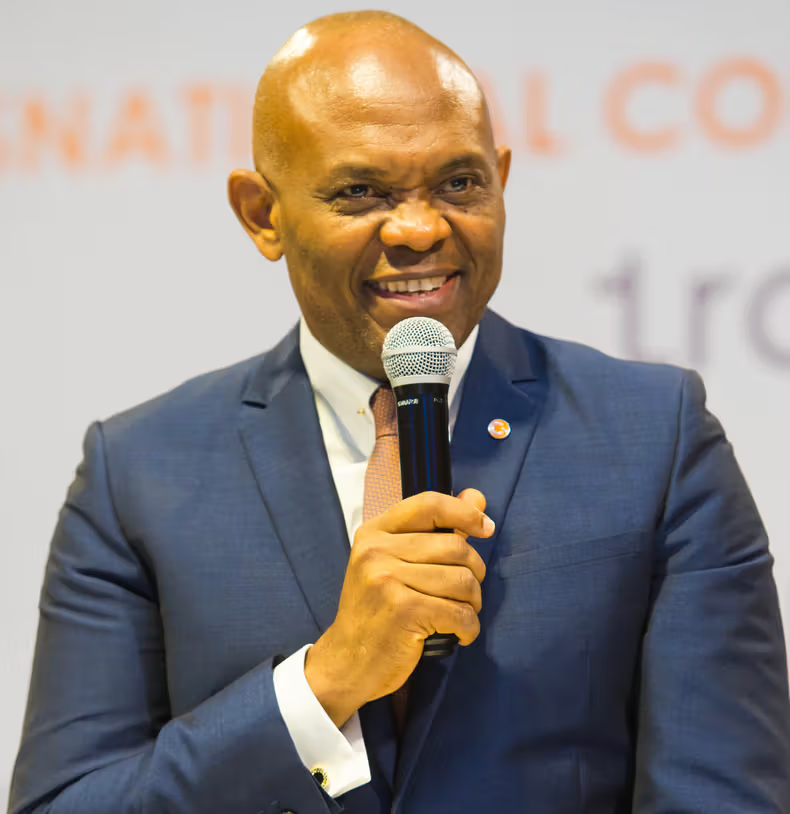
 Nigerian entrepreneur, banker, and philanthropist Tony Elumelu has once again called on African investors to channel their wealth and resources back into their home economies, emphasizing that Africa’s path to sustainable prosperity lies in local investment, strong policy frameworks, and trust between government and the private sector.
Speaking at the Abuja Business and Investment Summit & Expo 2025, held under the theme “Empowering Sustainable Growth: Unlocking Potential in Emerging Markets,” Elumelu — Chairman of Heirs Holdings and United Bank for Africa (UBA) Plc — urged African policymakers to prioritize stability, transparency, and predictability in governance. These, he said, are essential ingredients for attracting both local and foreign investment.
“No nation has achieved sustained prosperity without a vibrant private sector,” Elumelu declared. “Africa’s economic destiny will not be shaped by aid or charity, but by empowering businesses to grow under consistent and transparent policies.”
The Private Sector: Africa’s Engine for Growth
According to Elumelu, the private sector remains the backbone of Africa’s economic transformation. He pointed out that private enterprises contribute more than 70 percent of Africa’s Gross Domestic Product (GDP) and account for over 80 percent of employment opportunities across the continent.
He highlighted that countries that have managed to create enduring prosperity — from Asia to Europe — share one thing in common: a thriving private sector operating under stable policy conditions. Africa, he noted, must adopt a similar approach if it hopes to unleash its full economic potential.
“Entrepreneurs are the real catalysts for transformation,” he explained. “When governments create the right environment, business leaders and innovators can do what they do best — create jobs, stimulate industries, and build wealth.”
“Trust Is the Currency of Investment”
Elumelu’s comments were grounded in decades of experience navigating Africa’s often unpredictable business terrain. Through UBA, which operates in 20 African countries, and Heirs Holdings, with interests in financial services, energy, hospitality, and real estate, Elumelu has witnessed firsthand how inconsistent policy decisions can erode investor confidence.
“Trust is the true currency of investment,” he said. “Policy stability converts trust into capital. Investors — both local and foreign — need to know that the rules won’t suddenly change overnight.”
He stressed that while African leaders often call for increased foreign direct investment (FDI), they must also recognize that local investors form the foundation of confidence in any economy. “If African governments do not build trust with their own business communities,” he warned, “foreign investors will remain hesitant.”
Proof of Concept: Private Capital Driving Real Development
To illustrate how private capital can transform economies, Elumelu cited several initiatives spearheaded by his companies in Nigeria. The revitalisation of the Transcorp Hilton Abuja, the creation of the Transcorp Event Centre, and reforms implemented within the Abuja Electricity Distribution Company are, in his view, clear examples of what can be achieved when policy frameworks support private enterprise.
“These projects are not just about profit,” he said. “They are about impact — creating jobs, supporting communities, and improving infrastructure. This is what happens when the private sector and government work together with mutual respect and shared purpose.”
The Infrastructure Challenge: Africa’s $108 Billion Gap
Elumelu’s message aligns closely with recent findings by the African Development Bank (AfDB), which reports that Africa faces an annual infrastructure financing deficit of approximately $108 billion. This gap, if not addressed, continues to hinder trade, investment, and industrialization efforts across the continent.
Despite Africa’s growing influence in global arenas such as trade, entertainment, sports, and politics, persistent challenges — including policy uncertainty, high youth unemployment, mounting debt, and skill shortages — continue to constrain economic growth. Elumelu argued that addressing these issues requires not only financial commitment but also strategic collaboration between the public and private sectors.
“Governments must move from seeing the private sector as competitors or adversaries,” he said, “and instead view us as partners in nation-building.”
A Call for a New Social Contract
In what he described as a “new social contract,” Elumelu called for a reimagined partnership between African governments and the business community — one grounded in trust, transparency, and accountability. He emphasized that sustainable growth will only be possible when both sides recognize their shared responsibilities.
“Government’s role is to create an enabling environment,” he explained. “The private sector’s role is to invest, innovate, and deliver solutions. Together, we can create a future where African economies no longer depend on aid but thrive on enterprise.”
“Make Your Money — But Invest It at Home”
Perhaps his most powerful message was directed at African investors themselves. Elumelu urged them to demonstrate faith in their own markets by reinvesting profits within the continent rather than parking capital in foreign economies.
“How can we expect foreign investors to invest in us if we ourselves do not invest in our own economies?” he asked pointedly. “By all means, make your money — but please bring it home. Invest locally. It is an act of patriotism, and it is how we build lasting prosperity for our children and our continent.”
Elumelu warned that the growing trend of capital flight — where African wealth is stored abroad instead of being reinvested locally — undermines domestic growth and widens inequality. “It is a huge disservice to our nations,” he said. “We must believe in Africa enough to invest in Africa.”
Looking Ahead: Building Africa’s Economic Future
Elumelu concluded his address by reiterating that Africa’s transformation will not come from external aid or sporadic reforms, but from consistent, visionary leadership and empowered entrepreneurship. With Africa’s young population, expanding markets, and abundant natural resources, he said the continent has all the ingredients for success — if only it can build the right foundation of trust and stability.
“The future of Africa is in our hands,” he said. “Let us invest in our people, our businesses, and our communities. Let us create the Africa we want — one investment at a time.”

Leave a Reply